
Commercial property owners who are dissatisfied with their current property manager face an uncomfortable dilemma. The service isn’t working – the monthly reports are inadequate, maintenance is being mishandled, rent collection is sloppy, or the relationship has simply deteriorated past the point of recovery. But the cost of a badly managed transition can feel worse than staying put: confused tenants, maintenance gaps, financial records that don’t transfer cleanly, an outgoing manager who stops cooperating the moment notice is given. This is why many owners who should switch commercial property managers don’t.
The good news: a commercial property management transition is entirely manageable with the right structure. None of the risks are inevitable. They’re all products of an unplanned handover – and all of them are preventable with a documented process. This article walks through that process step by step, from reading your management agreement before giving notice to handing every vendor relationship to the incoming team.
Before You Give Notice: Read Your Management Agreement
This is the step most owners skip – and skipping it is expensive. Before you do anything else, read your commercial property management agreement carefully. Specifically, look for:
- Termination notice period. Most commercial property management agreements require 30–90 days written notice. Some distinguish between termination with cause (shorter notice permitted) and without cause.
- Termination fees or penalties. Some agreements charge a fee – often one or two months’ management fees – for early termination before the end of a fixed term.
- Post-termination obligations. What the outgoing manager is contractually required to deliver and when.
- Leasing commission exclusivity. Some agreements give the outgoing manager the right to collect a commission on any lease signed within 6–12 months of termination for tenants they introduced. Know this before you sign anything.
Ontario commercial property management agreements are purely contractual – they are not governed by the Residential Tenancies Act or any property management regulatory framework. Your rights are exactly what the agreement says they are. If there is any ambiguity about the termination provisions, get legal advice before giving notice.
One useful way to frame the decision: does your current monthly reporting look like what a professional manager’s reporting should look like? Our article on the commercial operating budget: what owners should see every month describes the minimum standard for monthly financial reporting in detail. If your current report doesn’t meet that standard, you have a documented basis for dissatisfaction – and a clear benchmark for evaluating whether the next manager is actually better.
On fees: if the management agreement includes a termination fee, benchmark it against the industry. Our breakdown of average property management fees for rentals in Ontario gives you the reference points to assess whether the fee in your agreement is standard or inflated.
Our property management company transition service reviews management agreement termination provisions as part of the transition planning process, so you understand exactly what you’re dealing with before the first notice goes out.
What You Must Receive From the Outgoing Manager
When a commercial property management agreement terminates, the outgoing manager is obligated to transfer all property-related documents, funds, and operational information. In practice, the quality of this transfer depends heavily on whether you’ve specified exactly what you need and by when. A vague “hand everything over when you’re done” produces a vague, incomplete handover. Here is the complete list of what you should require:
Financial Records
- Operating bank account balance and a full reconciliation covering the final period of management.
- Rent ledger by tenant: amounts charged, amounts collected, arrears by tenant and by period, and any pre-paid rent held.
- All security deposits held in trust with a written reconciliation showing: tenant name, deposit amount, date collected, any deductions applied, and current balance.
- Operating cost reconciliation for the current year-to-date – the data that will feed the year-end TMI reconciliation your tenants are contractually entitled to receive.
Legal Documents
- All original signed leases – not photocopies. Originals.
- Lease abstracts if they exist.
- Current rent roll showing: base rent, next payment due date, arrears, upcoming renewal options, and lease expiry dates.
Building Operations
- All maintenance contracts and vendor agreements: vendor names, contact information, contract terms, renewal dates, and any scheduled maintenance upcoming.
- Outstanding repair orders and their current status.
- HVAC service records and equipment maintenance logs.
- All permits, warranties, and equipment manuals.
- Utility account numbers and service provider contacts.
- Property insurance certificate and renewal date.
- Property tax bills for the current year and prior year.
- All keys, access fobs, security codes, and alarm credentials.
Every item on this list belongs to you as the property owner, not to the management company. Our accounting and bookkeeping service maintains all financial records in owner-accessible formats throughout the management relationship – which is why our clients don’t face a scramble to reconstruct records at transition time. A professional inspection at the handover date is also advisable: our property inspection services establish a documented baseline that protects both the outgoing and incoming manager from disputes about building condition. And the incoming manager’s move-in and move-out management protocols need to be operational from the first day of their tenure.
Communicating the Transition to Your Commercial Tenants
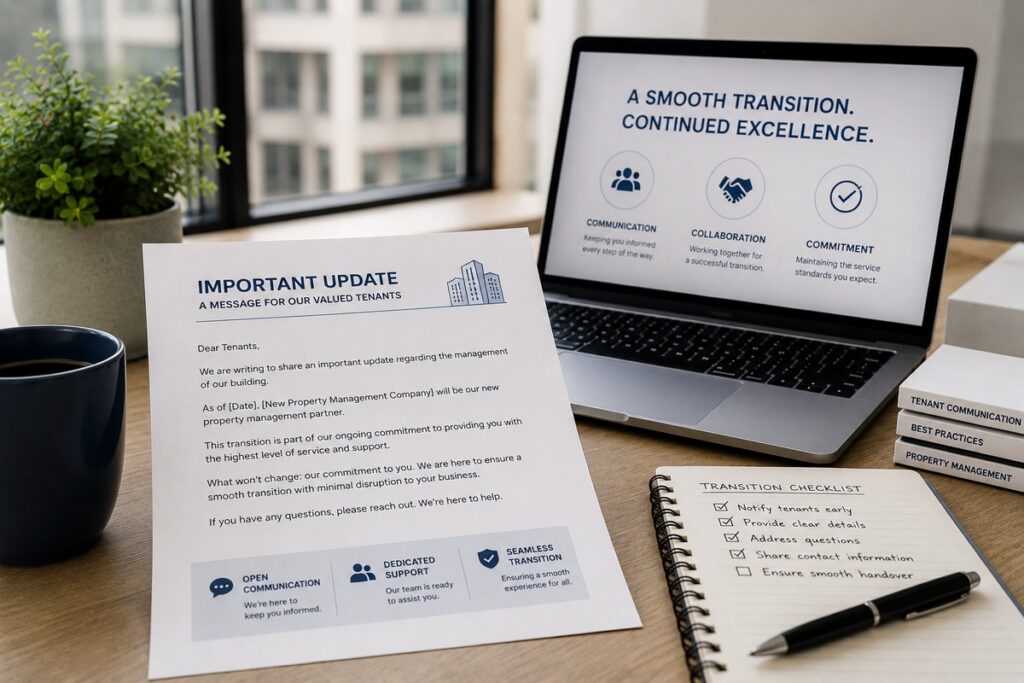
Tenant communication is where most commercial property management transitions go wrong. The failure modes are predictable: tenants don’t know where to send rent under the new manager, they don’t have emergency contact information for building issues, they feel blindsided by the change, and the first impression of the new management relationship is confusion rather than confidence.
Send a formal written notice to every commercial tenant at least 30 days before the transition date. The notice must contain all of the following:
- The effective date of the management change.
- Full contact information for the new property manager: office phone, email address, and 24-hour emergency contact.
- New payment instructions: where to send rent, new banking details, and the reference number format to use.
- New maintenance request process and contact information.
- A clear statement that all existing lease terms remain unchanged – the management change does not affect the tenant’s rights or obligations under their lease.
The structure of this communication borrows from the principles behind a strong tenant welcome package – the same instinct to set clear expectations and demonstrate professionalism from the first interaction applies here. New management arriving with organised communication is a very different experience from tenants piecing together what happened after the fact.
Making sure the new rent collection service is operational and tenants have the correct payment information before the first rent date under new management is critical. A payment made to the wrong account on day one creates unnecessary friction with tenants who were doing everything right.
Anchor Tenant Communication Deserves Special Attention
For major tenants whose leases represent a significant portion of the building’s income, the formal notice alone isn’t enough. A personal call or meeting from the property owner – or from the incoming manager – before the formal letter arrives demonstrates respect for the relationship and avoids the anchor tenant learning about the change secondhand. The tenants whose occupancy you most need to protect during a transition are exactly the tenants who should get a personal conversation, not just a letter. Strong tenant relationships built on a well-structured lease and thorough initial vetting – see our article on how to vet a commercial tenant’s financials before you sign – are the most resilient through a management change.
Most commercial leases include a “landlord’s right to assign management” clause. No tenant consent is required for a management change. However, any lease that contains a specific provision about management – unusual but possible – should be reviewed by legal counsel before proceeding.
Financial Transition: Accounts, Deposits, and Arrears
Security Deposit Transfer
All tenant security deposits held in trust by the outgoing manager must be transferred to you or your new manager’s trust account, accompanied by the written reconciliation described above. The incoming manager’s accounting and bookkeeping infrastructure must be set up to receive and maintain these records in the correct format from day one. The new manager must verify each deposit amount against the individual lease terms before the transition is considered complete – any discrepancy between the reconciliation and the lease is a dispute to resolve before the handover, not after.
Rent Arrears at the Transition Date
Any rent arrears that exist at the transition date must be clearly assigned in the termination agreement: who is responsible for collection? The outgoing manager may argue it’s your problem since you’re terminating the relationship. You may argue it accrued on their watch and they bear responsibility. This must be resolved in writing before the transition date – not left to goodwill after the relationship is effectively over.
Mid-Year Operating Cost Reconciliation
If the transition occurs mid-year, the year-end operating cost reconciliation that your tenants are entitled to receive will span two management periods. Establish clearly in writing in the termination agreement: who prepares the year-end reconciliation, what operating records the outgoing manager must deliver and in what format, and the timeline for delivery. Your tenants’ right to receive the year-end reconciliation on the schedule their lease specifies is not affected by the management change. Our commercial operating budget article describes what the year-end reconciliation should contain and why getting it right matters for tenant relationships.
During the transition window – particularly if there are outstanding arrears or an unresolved reconciliation period – income protection is worth considering. Our rent guarantee program and our overview of rent default insurance in Ontario both speak to how owners can protect income during periods of operational uncertainty.
Vendor and Service Provider Transition
Commercial properties carry multiple ongoing vendor relationships: HVAC service contracts, common area cleaning, security monitoring, parking management, landscaping, elevator maintenance, and fire safety inspection agreements. Each one requires attention during the transition.
- Notify all vendors in writing of the management change, new payment contact information, and new operational contact before the transition date. Vendors who don’t know who to call for approvals will either stop working or keep working and invoice the wrong entity.
- Collect copies of every service contract and review the term, notice period, and auto-renewal clause for each. Auto-renewals that trigger within 60 days of your transition date need an immediate decision – if you’re replacing a vendor, you need to give notice before the auto-renewal locks you in.
- Request vendor performance records from the outgoing manager for each service. Are they actually showing up and performing? A management transition is a natural opportunity to re-evaluate vendor relationships, not just carry them forward by default.
Our property maintenance service brings an established contractor network to every property we manage – which means the vendor transition is often an upgrade, not just a substitution. One category that needs immediate confirmation: 24-hour emergency coverage. Our emergency property management services must be in place and confirmed with tenants before the outgoing manager’s emergency contact is removed from the building.
How Long a Commercial Transition Should Take – and What to Look for in a New Manager
Transition Timeline
A well-managed commercial property transition requires 30–60 days for a smaller property (under 10 commercial tenants). Larger properties with complex lease structures, multiple operating accounts, or significant deferred maintenance may require 60–90 days to transition cleanly. The timeline should be formalised in the termination agreement with specific deliverables and delivery dates – not left as a vague “when the outgoing manager is ready” commitment.
Our property management company transition service manages the full handover process with a verified checklist, confirmed before the termination is finalised. We’ve handled transitions from managers who cooperated fully and from managers who didn’t – the process is the same in both cases.
If you’re considering managing the property yourself during the gap while you find a new manager, our article on the property management dilemma: pros and cons of DIY management addresses that decision honestly. And if you’re re-evaluating whether professional management is right for your situation at all, should you hire a property manager or do it yourself covers the decision framework.
What to Look for in the New Manager
Changing managers to solve a reporting problem only works if the new manager’s reporting is actually better. Ask every prospective manager for a sample monthly report before engaging them. Compare it against the standard our commercial operating budget article describes. Key additional criteria:
- Direct experience with your specific property type – a retail plaza requires different expertise than an industrial park or a mixed-use building.
- Portfolio size relative to staffing – a 2-person operation managing 200 properties is structurally different from a team of 15 managing 40.
- References from current clients specifically about transition experience and first-year operational performance.
- Fee structure transparency – see our guide on average property management fees for rentals in Ontario for benchmarks.
- Termination provisions in the new management agreement – so you’re not making the same mistake twice.
Frequently Asked Questions
How much notice do I need to give my commercial property manager to terminate?
This is determined entirely by your management agreement – there is no statutory notice period for commercial property management in Ontario. Most agreements require 30–90 days written notice. Some require formal cause for early termination before the end of a fixed term, or include an early termination fee. Read your agreement carefully and get legal advice if the provisions are ambiguous. Our property management company transition service reviews your agreement’s termination provisions as part of the transition planning process.
Can my tenants object to a management company change?
In most commercial leases, the landlord has the right to change property managers unilaterally – no tenant consent is required. However, any lease that contains a specific provision about management should be reviewed by legal counsel before the change. The most important protection for tenants is advance written notice – 30 days minimum – with clear new payment and contact information. For communication structure guidance, see our article on how to create a tenant welcome package that sets the right tone – the principles translate directly to management transition communications.
What happens to tenant security deposits when I switch property managers?
All security deposits held in trust by the outgoing manager must be transferred to you or your new manager, accompanied by a full written reconciliation. The transfer must happen on or before the effective transition date – not at the outgoing manager’s convenience. Verify each deposit amount against the individual lease terms before the transition is confirmed complete. Any discrepancy must be resolved before the handover is finalised.
How do I handle an operating cost reconciliation that spans two management periods?
Establish in writing, in the termination agreement, exactly who is responsible for preparing the year-end reconciliation, what operating records the outgoing manager must deliver, the format of those records, and the delivery timeline. Your tenants have a contractual right to receive the reconciliation on the schedule their lease specifies – a management transition does not extend that deadline. For a complete description of what the year-end reconciliation should contain, see our commercial operating budget article.
What is the biggest mistake owners make when switching commercial property managers?
Failing to get the complete, itemised handover from the outgoing manager before the transition date. Once the outgoing manager is no longer being paid and the relationship is effectively over, their motivation to cooperate on document delivery, financial reconciliations, and vendor introductions drops sharply. The full handover checklist – leases, deposits, financial records, vendor contracts, maintenance records, keys, and access credentials – must be received, verified, and confirmed complete before the termination is finalised. Our property management company transition service manages this verification process on your behalf.
Switching Commercial Property Managers in the GTA?
Our property management transition service is designed specifically for commercial property owners who need a structured, low-disruption handover. We manage the document transfer, tenant communication, vendor transition, and financial reconciliation – so you can focus on the outcome rather than the process.
→ Property Management Transition Service