Moving from residential rentals into commercial real estate can create an expensive false sense of familiarity. The properties may be in the same province, but the legal and operational rules are fundamentally different.
Ontario’s Residential Tenancies Act (RTA), 2006 establishes detailed protections and procedures for most residential tenancies. Commercial relationships depend much more heavily on the negotiated lease, supplemented by the Commercial Tenancies Act (CTA), common law and other applicable legislation.
These differences affect how you structure rent, collect deposits, recover operating costs, respond to arrears, approve alterations and terminate a tenancy. A process that is routine in a commercial building could be prohibited in a residential one.
If you own both property types, understanding the differences between Ontario’s Commercial Tenancies Act (CTA) and Residential Tenancies Act (RTA) is essential because each one affects how you manage rent, leases, tenant issues and enforcement.
1. Governing Legislation and Dispute Forums
The first difference concerns which law applies and where disputes are decided.
Most residential rental units are governed by the RTA. However, coverage does not depend solely on the building’s size or whether it is a house, condominium or apartment building. The Act contains specific exclusions, including certain arrangements where an occupant must share a kitchen or bathroom with the owner or a member of the owner’s immediate family.
The Landlord and Tenant Board (LTB) generally handles disputes covered by the RTA, using prescribed notices, applications, and procedures.
The CTA applies to commercial tenancies, including many retail, office, industrial and other non-residential leasing arrangements. Commercial disputes are generally court matters rather than LTB matters. The appropriate court and procedure depend on the remedy sought, the value of the claim and the nature of the dispute.
The practical management difference is significant:
- Residential enforcement is highly procedural and statute-driven.
- Commercial enforcement begins with the lease, followed by the CTA and applicable common law.
- Residential notices and LTB forms cannot simply be reused for commercial tenants.
- Commercial remedies may be faster in some circumstances, but an incorrect step can still expose the landlord to substantial liability.
For owners searching for information about the Commercial Tenancies Act in Ontario, the most important starting point is this: the Act does not provide a complete commercial management system. The lease remains the central operating document.
2. Commercial Rent Control and Rent Increases
Ontario limits increases for many existing residential tenancies. For 2026, the provincial residential rent increase guideline is 2.1%, although exemptions and above-guideline procedures may apply.
A residential landlord must also follow rules concerning timing, notice and the interval between increases. The guideline does not apply to every unit, including certain units first occupied for residential purposes after November 15, 2018.
There is no equivalent general commercial rent control in Ontario. Commercial rent is determined by the lease and the parties’ negotiations.
A commercial lease may provide for:
- Fixed annual increases
- Percentage-based increases
- Consumer Price Index adjustments
- Market rent reviews
- Percentage rent based on tenant sales
- A different rental rate during an extension or renewal term
For example, a five-year lease might set base rent at $30 per square foot in the first year and increase it by 3% annually. If the provision is properly drafted, the increase is not restricted by the residential guideline.
A landlord also cannot assume that rent may be increased during the term whenever market conditions change. Even without statutory commercial rent increase limits, the lease controls when and how rent changes.
Renewals require equal care. A renewal option may prescribe a formula, refer to fair market rent or establish an arbitration process. If the lease does not grant a renewal right, a landlord may negotiate a new rate, but the tenant is not obligated to accept it.
Accurate increases and recoveries should be reflected in the property’s commercial operating budget so revenue projections remain consistent with the executed leases.
3. Residential Standard Leases vs. Commercial Negotiated Leases
Ontario requires most landlords of private residential units to use the provincial standard form of lease. Additional terms may be attached, but they cannot remove rights or obligations established by the RTA.
There is no prescribed standard form for most commercial leases.
A commercial lease can range from a relatively short agreement for a small unit to a lengthy, highly negotiated document covering complex financial and operational obligations. Common provisions address:
- Base rent and additional rent
- Operating costs, taxes and insurance
- Permitted use
- Exclusive-use rights
- Repairs and maintenance
- Tenant improvements
- Signage
- Environmental obligations
- Assignment and subletting
- Insurance and indemnity
- Defaults and remedies
- Guarantees and other security
- Renewal, relocation or expansion rights
- Surrender and restoration requirements
This is one of the most consequential differences between commercial and residential leases. Residential landlords operate within an extensive statutory framework. Commercial landlords must ensure that the lease clearly states how the parties intend the property to operate.
A vague commercial lease can create uncertainty about costs, access, maintenance and remedies for years. Before signing, the lease should be reviewed from both a legal and an operational perspective. The property manager must be able to administer what the document requires.
4. Commercial Security Deposits

Under the RTA, a residential rent deposit cannot exceed the lesser of one month’s rent or the rent for one rental period. It must be applied to the final rental period, and the landlord must pay the prescribed interest. A refundable key deposit may be permitted, but it cannot exceed the expected replacement cost.
The rules are different for a commercial security deposit in Ontario.
Commercial security arrangements are generally negotiated between the parties. Depending on the transaction, a landlord may request:
- A cash security deposit
- Prepaid first and last month’s rent
- A letter of credit
- A personal or corporate guarantee
- Several months of gross rent as security
- A combination of these protections
The appropriate amount should reflect actual risk. A well-established tenant with strong financial statements and significant assets may justify a different security package from a newly incorporated business with limited operating history.
Security should not be chosen by habit. Before deciding what to request, examine the tenant’s liquidity, profitability, existing debt, ownership structure and expected investment in the premises. Our guide to vetting a commercial tenant’s financials explains what to review before committing to a lease.
The lease must also explain when the landlord may draw on the security, whether the tenant must replenish it and how any remaining amount will be returned.
5. Distraint as a Commercial Landlord Remedy
Distraint, also called distress, is a remedy that may allow a commercial landlord to seize goods located at the leased premises to address rent arrears. Residential landlords cannot use this remedy against tenants covered by the RTA.
That does not mean a landlord should enter a commercial unit and begin removing property.
The CTA establishes rules governing commercial distraint, and common law principles also affect how the remedy is used. Questions involving ownership, statutory exemptions, secured creditors, the definition of rent and the method of sale can make a seemingly straightforward seizure legally complex.
Before considering distraint under a commercial lease in Ontario, confirm:
- The lease has not already been terminated.
- The amounts claimed qualify as rent for distress purposes.
- The landlord has not taken another step that is inconsistent with distraint.
- The property being considered can lawfully be seized.
- Secured interests and third-party ownership have been investigated.
- The required inventory, appraisal, notice and sale processes will be followed.
A landlord generally cannot distrain after terminating the lease because distraint treats the landlord-tenant relationship as continuing. Choosing between distress, re-entry and a court claim therefore requires strategic legal analysis.
Improper distraint may expose the landlord to damages. A licensed bailiff and legal counsel should be involved before action is taken. The commercial rent arrears escalation process should also be documented so the response is proportionate, consistent and supported by the lease.
6. Termination for Non-Payment
A residential landlord cannot remove a tenant or change the locks simply because rent is unpaid. The landlord must serve the appropriate RTA notice, apply to the LTB and obtain an enforceable eviction order.
The commercial process is different.
Section 18 of the CTA provides a statutory right of re-entry when rent remains unpaid for 15 days, provided the lease and surrounding circumstances do not alter the applicable right. Commercial leases commonly contain their own default and re-entry provisions as well.
This can allow a commercial landlord to regain possession without first obtaining an LTB order. However, a lockout is not risk-free.
Before a commercial eviction in Ontario, the landlord should verify:
- The exact amount and nature of the arrears
- Whether the statutory 15-day period has passed
- Whether the lease provides an additional notice or cure period
- Whether rent has been accepted after the default
- Whether the tenant has raised a legitimate dispute about additional rent
- Whether insolvency proceedings have created a stay
- How the tenant’s property will be secured and documented
- Whether the tenant may seek relief from forfeiture
A court can grant relief from forfeiture in appropriate circumstances, potentially restoring the lease after re-entry. Relief may be considered where the tenant pays the arrears, remedies the default and compensates the landlord.
Commercial enforcement may move more quickly than residential enforcement, but speed does not excuse incomplete records or an incorrect calculation. The rent ledger, notices, lease clauses, communications and evidence of re-entry should all be preserved.
7. Commercial Notice Requirements
Residential termination uses prescribed forms and statutory timelines. The correct notice depends on the reason, such as non-payment, substantial interference, damage or an illegal act.
Commercial leases do not use the RTA’s N4, N5 or N6 notices.
For commercial tenancies, the required process depends on the type of default, the lease and the CTA. Rent arrears are treated differently from many non-rent breaches. For certain other defaults, the CTA restricts re-entry unless the landlord has served notice identifying the breach and, where the breach can be remedied, requiring the tenant to correct it and compensate the landlord.
A well-drafted lease should define:
- Events of default
- Notice delivery methods
- Cure periods
- When a default is incapable of remedy
- The landlord’s re-entry rights
- Interest and administrative charges
- Recovery of enforcement costs
- Continuing liability after termination
A commercial lease termination notice in Ontario should identify the correct default and follow the delivery method required by the lease. Sending notice by ordinary email may be insufficient if the agreement requires personal delivery, registered mail or delivery to a specified address.
Poor notice administration can weaken an otherwise valid claim. Maintain a lease abstract that records every notice address, delivery method and cure period before a default occurs.
8. Operating Cost Recovery (TMI)

Residential rent generally covers the landlord’s ownership and operating costs. Utilities and certain services may be allocated separately when the tenancy agreement and legislation permit, but residential landlords do not normally issue a commercial-style annual reconciliation for property taxes, building insurance and common-area maintenance.
Commercial leases often use a very different structure.
Under a net or semi-gross lease, tenants may pay base rent plus a proportionate share of eligible operating expenses. These charges are frequently called additional rent, operating costs or TMI, meaning taxes, maintenance and insurance.
Depending on the lease, recoverable amounts may include:
- Property taxes
- Building insurance
- Common-area utilities
- Cleaning and waste removal
- Snow removal and landscaping
- Security
- Repairs and preventative maintenance
- Property management or administration fees
The ability to recover a cost does not arise merely because the landlord incurred it. The expense must fall within the lease’s definition of additional rent. Exclusions may apply to capital expenditures, financing costs, leasing commissions, structural work, landlord income taxes and costs caused by another tenant.
This is why the difference between TMI in a commercial lease and residential tenancy changes the owner’s accounting obligations. Commercial landlords need defensible budgets, consistent allocation methods and timely year-end reconciliations. Weak documentation can turn a recoverable expense into a tenant dispute.
9. Alterations and Tenant Improvements
The line between residential and commercial alteration rights is not as simple as saying residential tenants may alter their units freely. Residential tenancy agreements may restrict painting, fixtures and other changes, and tenants can be responsible for undue damage.
Residential landlords must also consider their duty to accommodate disability-related needs under Ontario’s Human Rights Code. The Ontario Human Rights Commission’s rental housing policy explains how accommodation obligations can affect housing decisions.
Commercial leases normally contain much more detailed alteration provisions. They may require the tenant to submit plans, obtain written approval, use approved contractors and comply with building standards.
A commercial tenant alterations clause should address:
- Plans and specifications
- Building permits and regulatory approvals
- Structural and building-system work
- Contractor insurance
- Construction liens
- Hours of work
- Utility shutdowns
- Ownership of improvements
- End-of-term removal and restoration
For example, a restaurant fit-out may affect ventilation, plumbing, electrical capacity, fire suppression, grease management and accessibility. A simple consent email is not enough to manage those risks.
Document the original condition before possession, every approved change during the term and the restoration standard that will apply when the tenant leaves.
10. Assignment and Subletting
Under the RTA, a residential tenant may request permission to assign or sublet. The Act restricts a landlord from arbitrarily or unreasonably withholding consent to a proposed assignment or sublet, and specific remedies may be available when general assignment consent is refused.
Commercial assignment is more contractual.
A commercial lease may prohibit assignment or subletting without the landlord’s prior written consent. Ontario’s CTA can imply a standard that consent will not be unreasonably withheld unless the lease expressly provides otherwise, so the exact wording matters.
A commercial lease may also define situations that are treated as assignments even when the tenant does not formally transfer the lease, including:
- A change in corporate control
- A transfer of shares
- An amalgamation
- A franchise transfer
- A licence to another occupant
- A transfer to an affiliated company
When reviewing commercial subletting in Ontario, do not assess only the proposed occupant’s name. Review its financial strength, intended use, operating history, insurance, reputation, compatibility with other tenants and ability to meet the lease obligations.
Consent should also address whether the original tenant and guarantors remain liable. Approving a transfer without preserving that liability can reduce the landlord’s security.
11. Personal Guarantees
Personal guarantees are common in commercial leasing, especially when the tenant is a newly incorporated or thinly capitalized business. They are not a standard feature of ordinary residential tenancies.
A personal guarantee for a commercial lease in Ontario may appear within the lease or in a separate agreement. A separate document can improve clarity, but enforceability does not automatically depend on physical separation from the lease.
What matters is whether the guarantee is clearly drafted, properly executed and supported by the surrounding transaction.
The document should state:
- Which tenant obligations are guaranteed
- Whether liability is limited by amount or time
- Whether liability continues after renewal or extension
- Whether amendments require the guarantor’s consent
- What happens after assignment
- Whether the guarantor is liable for rent, damages and enforcement costs
- When the landlord may make a demand
The outline’s suggestion that every guarantor is automatically jointly and severally liable is too broad. Liability depends on the guarantee’s language.
A guarantee should also be reviewed whenever the lease is materially amended. Significant changes made without the guarantor’s consent can create enforceability disputes. Independent legal advice for the guarantor may strengthen the documentation and reduce later claims of misunderstanding.
12. Landlord Access and Tenant Privacy
The RTA closely regulates residential entry. Except in emergencies and other limited circumstances, a landlord generally must give at least 24 hours’ written notice, state the reason for entry and enter between 8 a.m. and 8 p.m.
Commercial access is usually governed by the lease. There is no universal CTA rule that reproduces the residential 24-hour notice framework.
A commercial lease may authorize access for:
- Inspections
- Repairs and maintenance
- Emergency response
- Environmental testing
- Compliance investigations
- Mortgagee or insurer inspections
- Showing the premises near the end of the term
- Work affecting building systems
Broad contractual language does not justify careless entry. A landlord must still act lawfully and consider the tenant’s right to use the premises without unreasonable interference.
Effective commercial landlord access rights in Ontario should be supported by an operational protocol. Give reasonable notice where circumstances allow, explain the purpose of the visit, coordinate around sensitive business activities and keep a record of who entered.
For medical, financial, legal or technology tenants, access may also raise confidentiality, security and privacy concerns. The lease should address keys, alarm codes, restricted areas and emergency contacts before an urgent situation occurs.
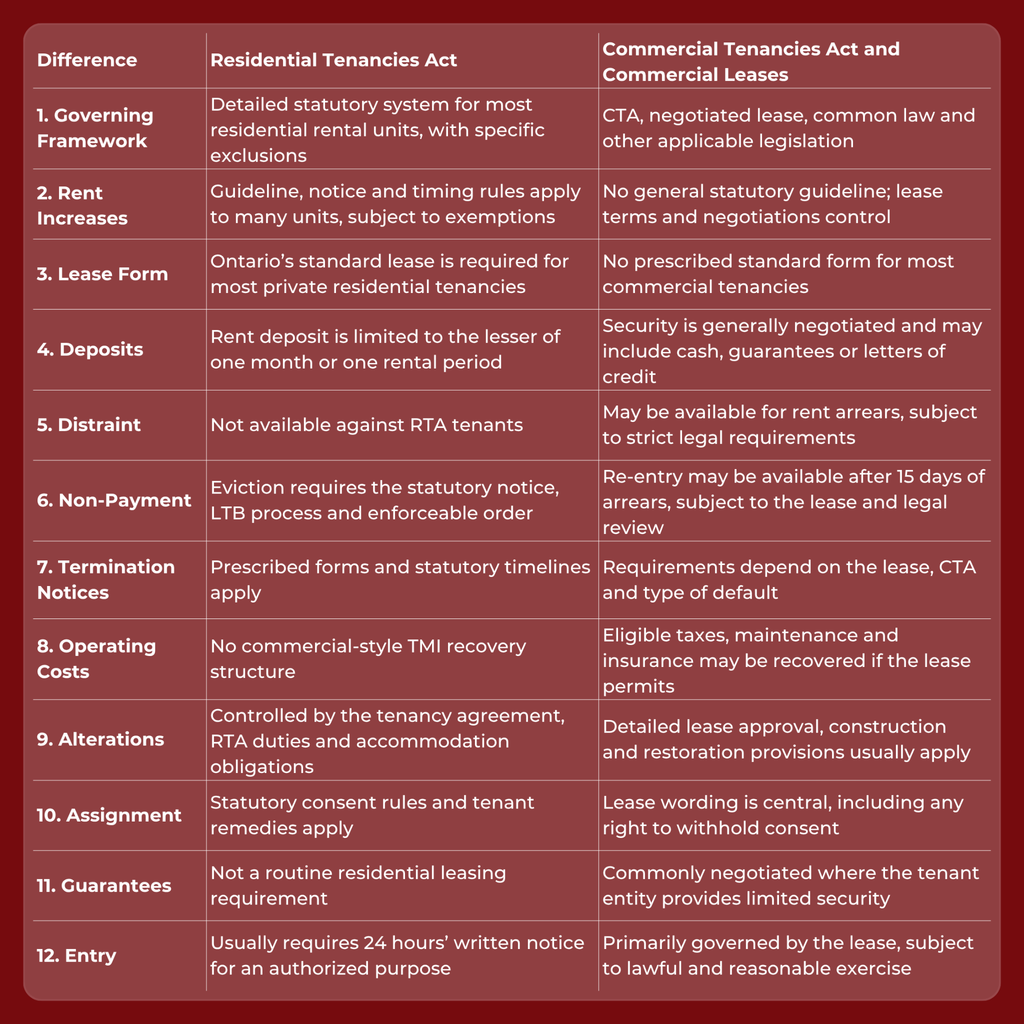
RTA vs. CTA: Side-by-Side Reference
The following table summarizes the operational differences between the two frameworks.
Manage Commercial Property According to the Lease You Actually Have
The central difference between Ontario’s residential and commercial tenancy systems is the role of the contract. Residential management is shaped by detailed statutory protections and prescribed procedures. Commercial management depends far more heavily on the lease, supported by the CTA and common law.
That flexibility can give commercial owners stronger remedies and broader cost-recovery rights. It also creates greater responsibility. Rent calculations, notices, access, reconciliations and enforcement decisions must match the executed agreement.
Our commercial property management service helps owners administer those obligations consistently, from lease abstraction and operating-cost recovery to rent collection and coordinated tenant eviction management.
We support owners across the GTA, including those seeking commercial property management in Toronto, Mississauga, Vaughan and surrounding communities. The right legal framework is the foundation, but disciplined day-to-day management is what protects the property’s income and long-term value.
Frequently asked questions
1. Does the RTA ever apply to a commercial property?
The RTA can apply to residential rental units located within a mixed-use property. For example, a building may contain retail premises at street level and residential apartments above. The commercial leases may be governed by the CTA and commercial law, while the apartments remain subject to the RTA.
The property’s general label does not decide the issue. The nature and use of each rental unit matter. Mixed-use owners therefore need separate procedures for leasing, deposits, entry, arrears and termination.
2. What happens if my commercial lease is silent on an issue?
The answer may come from the CTA, another statute or common law, but the result should not automatically be assumed to favour the landlord. Silence can create uncertainty about repair obligations, additional rent, assignment, access or remedies. In some situations, the absence of a clear provision may leave the landlord with fewer practical options than expected.
Before acting, have a legal professional review the entire agreement and applicable law. An isolated clause should not be interpreted without considering the rest of the lease.
3. Can a commercial tenant apply to the Landlord and Tenant Board?
Not for a tenancy that falls outside the RTA. The LTB’s jurisdiction is limited to matters assigned to it under residential tenancy legislation.
Commercial disputes are generally handled through the courts, negotiation, mediation or arbitration where the lease requires it. The appropriate forum depends on the amount claimed and the remedy being pursued. A claim for unpaid rent may follow a different route from an application concerning possession or relief from forfeiture.