Owning a commercial property should not mean waiting for a year-end statement to learn that expenses have drifted, a tenant has fallen behind, or a lease deadline was missed. Yet many owners receive little more than a bank deposit and a dense accounting export each month. The numbers may be accurate, but they lack the context needed for a timely decision.
A strong monthly commercial property report does more. It connects rent collection, operating costs, net operating income, reserves, distributions, and lease events in one consistent package. It tells you what happened, why it happened, how performance compares with the plan, and what needs your attention next.
This guide sets out a practical standard for a complete commercial property owner report template. It is designed for owners across Toronto and the GTA who want to assess their current reporting or compare the reporting practices of prospective property managers.
1. Executive Summary: The One-Page View
Every report should begin with a concise commercial property monthly summary that can be understood in less than three minutes.
The executive summary is not a substitute for the supporting schedules. It is the decision-making layer that helps you see whether the property is on plan before reviewing the detail. If the full report runs to 30 pages but the first page cannot tell you whether income, expenses, and occupancy are improving or deteriorating, the report is not doing its job.
At a minimum, the summary should show:
- Revenue Performance: Actual revenue for the month and year-to-date, each compared with budget.
- Operating Expense Performance: Actual operating expenses for the month and year-to-date, with dollar and percentage variances.
- Net Operating Income: Monthly and year-to-date net operating income (NOI) compared with budget and, where useful, the same period in the prior year.
- Occupancy: The percentage of leasable area occupied, with the prior month’s figure beside it.
- Arrears: The number of tenants in arrears, the total amount outstanding, and whether the balance is increasing or decreasing.
- Owner Actions: Decisions, approvals, or material risks that require attention.
The figures should come from the same records and budget schedules used throughout the report. Our guide to the commercial operating budget explains why an actual figure has limited meaning without an approved baseline.
The summary should distinguish information from action. A minor utility variance may need an explanation. A major repair, growing arrears balance, or approaching renewal deadline may require an owner decision by a specific date. Flag the deadline, responsible person, and recommended next step.
NOI deserves particular attention because it connects monthly operations to the broader performance of the asset. As explained in our guide to how commercial property is valued in Canada, changes in sustainable income can affect more than short-term cash flow. A small recurring expense overrun or vacancy may have a larger effect when considered in an income-based valuation.
2. Rent Roll: A Tenant-by-Tenant Revenue View

The rent roll should make it possible to trace revenue from each lease to the amount billed, collected, and outstanding.
A single line showing total rent collected is not enough. It may confirm that money entered the account, but it cannot show which tenants paid, whether additional rent was billed correctly, or where arrears are forming. A useful commercial rent roll format includes one row for every tenant and explicit rows for vacant units or spaces.
Each tenant row should contain:
- Tenant or business name
- Unit or premises identifier
- Leased area in square feet
- Lease commencement and expiry dates
- Current base rent
- Additional rent or taxes, maintenance, and insurance (TMI) charged separately
- Other charges or credits
- Total charged for the month
- Total collected for the month
- Outstanding arrears
- Age of the arrears
- Notes on disputes, payment plans, renewals, or other relevant matters
Separating “charged” from “collected” is essential. If a tenant was billed $12,000 but paid $9,000, a collection-only total can make the shortfall difficult to see. The commercial property rent ledger template should carry the unpaid $3,000 into the arrears balance and show how long it has remained outstanding.
The rent roll should also flag events coming up within the next 90 days, including rent steps, expiries, option deadlines, and operating cost adjustments. A 90-day flag is useful for immediate action, but it does not replace the rolling 12-month lease calendar discussed later in this guide.
Vacancy must be visible. Leaving a vacant unit out removes both the missing rent and the leasable area from view. Show the unit, square footage, date vacated, asking rent, leasing status, and relevant incentives being considered.
Reliable rent collection management should produce a clear ledger rather than an unexplained deposit total. The same information can reveal tenant payment patterns that deserve attention alongside the financial review completed before a lease is signed. For a deeper look at that process, explore our guide on how to vet a commercial tenant’s financials before you sign.
3. Operating Expenses: Budget Versus Actual by Category
A useful commercial property expense report shows whether costs are controlled, not merely what was paid.
Every operating expense line should have, at minimum, a monthly budget, monthly actual amount, and variance. The same comparison should be available year-to-date. Without the budget column, an owner can see that a snow-removal invoice was paid but cannot tell whether seasonal costs remain within the annual plan.
The schedule should separate the major categories relevant to the property, such as:
- Property taxes, recorded on a consistent accrual basis
- Insurance
- Utilities by type
- Cleaning and janitorial services
- Landscaping and snow removal
- Security
- Repairs and maintenance
- Management fees
- Legal, accounting, engineering, or other professional fees
Avoid a broad “miscellaneous” category. If an unusual cost isn’t clear from the account name, include a description. Repeated items should be assigned a stable category so that month-to-month comparisons remain meaningful.
Itemize Repairs and Maintenance
Repairs and maintenance require supporting detail because they are among the easiest expenses to misunderstand. A single $8,400 maintenance line does not tell you whether the amount covered an urgent roof repair, several routine service calls, or an invoice posted to the wrong property.
List each material work order with the vendor, service date, description, invoice number, amount, approval status, and whether the work is complete. Where a repair relates to an earlier inspection or tenant request, reference that record. Professional property maintenance management should give owners enough information to connect the invoice to the work performed.
Separate Capital Items from Operating Expenses
Capital projects should not be blended into ordinary operating expense lines. Keeping them separate protects the usefulness of NOI and makes reserve activity easier to reconcile.
This distinction also matters for tax records. The Canada Revenue Agency (CRA) explains that a current expense generally recurs after a short period, while a capital expense may provide a lasting benefit or improve property beyond its original condition. The result depends on the facts, so review the CRA’s current versus capital expense guidance and obtain accounting advice where needed.
Our guide to bookkeeping for commercial landlords explores how consistent classification and supporting records can make the file easier to review.
Explain Significant Variances
A practical policy is to require an inline explanation for any category more than 10% or $500 over budget, while adjusting those thresholds to suit the property’s size. The goal is not to treat every difference as a problem. It is to ensure material changes are noticed.
For example, “utilities 18% over budget” is incomplete. A better note might say that electricity consumption rose during a heat wave, that the rate remained consistent, and that the team is comparing equipment run times before the next report. The explanation identifies a cause and a follow-up action.
Management fees should be equally transparent. Show the agreed rate and calculation basis, such as a percentage of gross rent collected, where that is what the management agreement provides. The reported amount should be reproducible from the underlying figures.
4. Net Operating Income: Show the Calculation

NOI should appear as a clearly labelled calculation, not as a number the owner must reconstruct from separate schedules.
A straightforward NOI calculation for commercial property is:
Effective Gross Income − Operating Expenses = Net Operating Income
Effective gross income generally begins with base rent, additional rent, and other property income, adjusted for vacancy and collection loss as applicable to the reporting method. Operating expenses then reduce that income. Financing costs, income taxes, depreciation, and owner-specific expenditures are generally presented outside the property’s NOI calculation so that operating performance remains comparable. The precise treatment should be consistent with the property’s accounting policies and the purpose of the report.
Show NOI for:
- The current month
- Year to date
- The same period in the prior year
- The approved budget
- The trailing 12 months, when reliable data is available
The trailing 12-month figure smooths seasonal variation and can support financing discussions by presenting a full year of current operations. Lenders may use adjusted property income when assessing debt service coverage, although definitions vary. For renewal, keep the underlying ledgers, leases, invoices, and reconciliations ready.
For more context, review how NOI relates to the valuation of commercial property and how property income may be assessed differently in commercial mortgage financing.
Most importantly, reconcile NOI to the revenue and expense schedules in the same report. If the rent roll, expense report, and NOI calculation do not agree, the report should identify timing differences or accounting adjustments instead of leaving the owner to find them.
5. Capital Reserve Account Statement
The commercial property reserve fund statement should be included every month, even when there has been no activity.
The statement should show:
- Opening balance
- Contributions during the period
- The source of each contribution
- Disbursements, listed by capital project
- Approved commitments not yet paid
- Closing available balance
Suppose a property begins the month with a $120,000 reserve, contributes $10,000, and pays $35,000 toward an HVAC replacement. The closing cash balance is $95,000. If another $20,000 has been contractually committed but not yet invoiced, the report should also show that commitment so the owner does not mistake the entire $95,000 for unallocated funds.
Reserve reporting becomes more valuable when it connects money to condition. Regular property inspections can identify deterioration early, while property evaluation services can inform investment and capital planning. Neither replaces a formal building condition assessment where required.
For larger projects, add the approved budget, spending to date, forecast cost to complete, and expected completion date. This allows the owner to see whether a project is consuming reserves faster than planned before the account is depleted.
6. Owner Distribution Reconciliation
An owner distribution should be the final result of a visible calculation, not a stand-alone bank transfer.
The owner distribution for a commercial property can be reconciled as follows:
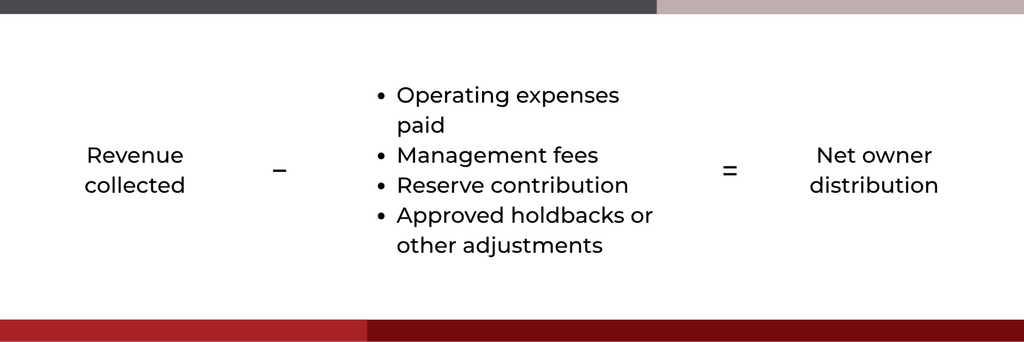
The reconciliation should appear before the distribution amount and use the same reporting period as the supporting schedules. If expenses were accrued in the income statement but not yet paid from cash, the report should make that distinction clear. NOI and distributable cash are related, but they are not always identical.
Holdbacks need a purpose, amount, and expected release date. A notation such as “$15,000 retained for roof work pending final invoice” is useful. “Other adjustment: $15,000” is not. When the holdback is released, the next report should show the movement so the owner can follow it from one period to the next.
Bank activity should also reconcile to the statement. That includes the opening cash balance, receipts, payments, reserve transfers, distribution, and closing balance. This is where good property accounting and bookkeeping turns a collection of transactions into an audit-ready record.
7. Lease Administration Calendar
A rolling commercial lease management calendar protects the value contained in the leases, not just the building.
Include the next 12 months of material dates for every tenant:
- Lease expiry dates
- Renewal option notice deadlines
- Rent escalation or step dates
- Operating cost estimate and reconciliation dates
- Insurance certificate renewal dates
- Option-to-purchase deadlines
- Expansion, contraction, or termination option dates
- Other notice periods created by the lease
The calendar should show the event date, the date on which action must begin, the party responsible, current status, and next step. A renewal option that expires in October may require the tenant to give notice six or 12 months earlier. Reporting only the lease expiry date could therefore flag the matter too late.
This schedule should also connect to leasing strategy. If three tenants representing 40% of the property’s leasable area expire within the same six-month period, the owner needs to see that concentration well in advance. The response may include early renewal discussions, market-rent analysis, space improvements, or contingency planning for vacancy.
Tenant financial quality also belongs in the decision, especially before extending a term or approving a material concession. Our guide to reviewing a commercial tenant’s financials explains the information that can support that assessment.
Red Flags in Your Current Commercial Property Management Reporting
Weak reporting often looks acceptable at first glance because it contains plenty of numbers, but these omissions should prompt questions:
- No Budget Comparison: Actual figures appear without monthly or year-to-date budget columns.
- No Tenant Detail: The rent roll shows only a total billed or collected.
- No Collection Gap: Charges and receipts are not separated, making arrears difficult to trace.
- Unexplained Maintenance: Repairs appear as one lump sum without vendors, invoices, or work-order detail.
- Missing NOI: Net operating income is absent or cannot be reconciled to the report.
- Hidden Capital Spending: Capital projects are mixed into operating expenses.
- No Monthly Reserve Balance: Reserve activity appears only quarterly or annually.
- Unreconciled Distribution: The owner receives a transfer with no calculation showing how it was derived.
- No Lease Calendar: Upcoming notice dates, rent steps, and expiries are not reported.
- No Action Log: Important issues are described but have no owner, deadline, or next step.
One missing item may be a configuration issue that can be corrected. A repeated pattern of incomplete records, unexplained variances, or missed lease events is more serious. If better reporting cannot be established, our guide to switching commercial property managers explains how to plan the handover while limiting disruption. A structured property management company transition should preserve tenant communication, financial records, leases, keys, contracts, and open work orders.
Better Reporting Leads to Better Decisions
A complete owner report does not need to be complicated. It needs to be consistent, traceable, and focused on decisions. When revenue, expenses, NOI, reserves, distributions, and lease events appear in one connected package, you can identify problems earlier and plan with greater confidence.
Our commercial property management service includes clear owner communication and financial oversight as part of the management process. We also support owners who need dedicated accounting and bookkeeping, broader property management for real estate investors, or an organized transition from another property management company.
We work with property owners across the GTA, including Toronto, North York, Etobicoke, and Scarborough; the western GTA communities of Mississauga, Oakville, and Brampton; and Vaughan, Markham, Richmond Hill, Pickering, and Oshawa.
Download the template, compare it with your latest statement, and note every figure you cannot trace or question you cannot answer. That short review will show whether your monthly report is supporting your decisions or simply recording the past.
Frequently Asked Questions
1. How often should I receive a commercial owner report?
Monthly reporting is the appropriate minimum for active commercial property oversight. Define the delivery date in the management agreement or reporting schedule. Weekly arrears or leasing updates may help in higher-risk situations, but they do not replace the complete monthly package. Quarterly reporting can allow issues to remain unseen for too long.
2. Can I request this report format from my current property manager?
Yes. Start by reviewing the reporting obligations, approval thresholds, record-access provisions, and delivery timing in the property management agreement. Your contractual rights depend on that agreement and the surrounding circumstances, so avoid assuming that every manager is automatically required to provide an identical format.
Even where the format is not prescribed, provide the template and ask the manager to adopt it. A constructive response should identify what is available, what requires system configuration, and when the complete format can begin. Resistance without a practical explanation may indicate that key records are not being maintained in a usable form.
3. What software do commercial property managers use to generate owner reports?
Commercial managers may use Yardi, MRI Software, AppFolio, Buildium, or other tools suited to the portfolio. No platform guarantees a complete report by itself.
The more important questions are whether the manager has entered the budget, maintained accurate lease data, reconciled bank and tenant ledgers, classified expenses consistently, and configured useful outputs. Good commercial property management reporting depends on reliable processes and review, not simply the software name in the footer.
4. Should every property use exactly the same report?
Keep the seven core sections consistent, but adapt the detail to the asset. A retail plaza may require percentage-rent and common-area cost reporting. An industrial property may emphasize roof, paving, and mechanical plans. A mixed-use asset may need separate cost-recovery schedules.
5. Who should review the monthly report?
The owner or designated asset representative should review it promptly, with support from an accountant, legal professional, leasing advisor, engineer, or lender where specialized advice is needed. The manager should identify exceptions and recommendations while preserving enough detail to verify the underlying position.