
A commercial appraisal that comes in below expectations can affect a sale, refinancing or investment plan. A buyer may no longer qualify for enough financing, while an owner refinancing a property may receive lower loan proceeds than expected.
However, a low appraisal is not necessarily an error. Commercial property valuation in Canada considers the property’s income, leases, operating expenses, condition, location and market risk. It is not based only on what the owner paid, the listing price or the value of a nearby building.
Understanding how appraisers reach their conclusions can help you review a low appraisal and prepare more effectively before the next one.
This article provides general information only. A formal appraisal should be completed by a qualified professional for the specific property, purpose and effective date.
The Three Approaches to Commercial Property Value
Canadian appraisers generally consider three approaches to value. The Appraisal Institute of Canada’s Canadian Uniform Standards of Professional Appraisal Practice require AIC members to use relevant market evidence and explain why an applicable approach was included or excluded.

The Income Approach
The income approach to commercial appraisal is commonly used for income-producing properties, including retail plazas, apartment buildings, offices and industrial buildings.
A simplified direct capitalization formula is:
Property value = Stabilized NOI ÷ Capitalization rate
Net operating income, or NOI, is generally the property’s effective income after applicable operating expenses but before mortgage payments, income taxes and financing costs.
For example, if a property has stabilized NOI of $150,000 and the appraiser selects a 6% cap rate:
$150,000 ÷ 6% = $2,500,000
The calculation is simple, but the appraiser must support both inputs. This means determining the property’s sustainable NOI and selecting a cap rate based on relevant market transactions and other evidence.
Accurate financial reporting is therefore important. Consistent accounting and bookkeeping can help owners produce the income and expense statements appraisers need.
The Direct Comparison Approach
The direct comparison approach examines recent sales of reasonably similar properties. Appraisers may compare sale prices per square foot, prices per unit, cap rates or other relevant measurements.
Adjustments may be required for differences in:
- Location
- Building size and age
- Property condition
- Parking and access
- Zoning
- Lease terms
- Tenant quality
- Vacancy and income
- Date and conditions of sale
A nearby sale is not automatically a good comparable. The appraiser must consider whether the property has similar physical, financial and market characteristics.
The Cost Approach
The cost approach generally considers the value of the land plus the cost of replacing or reproducing the improvements, less accrued depreciation.
Depreciation may include physical deterioration, outdated building features and external conditions affecting the property.
This approach can be particularly useful for newer or special-purpose properties where there are few comparable sales. For an established income-producing property, it may receive less weight than the income or direct comparison approach.
Why the Appraiser’s NOI May Be Lower Than Yours
One of the most common causes of a low commercial appraisal is a disagreement about NOI.
Some owners treat rent collected as NOI. However, gross rent is not the same as net operating income. An appraiser may adjust both income and expenses to reflect the property’s expected, sustainable performance.
Contract Rent Versus Market Rent
Existing leases can either support or limit value.
A below-market lease may restrict the property’s income until the lease expires. An above-market lease may produce strong income today, but the appraiser must consider whether that rent can be maintained when the tenant renews or the unit is leased again.
The analysis may consider:
- Remaining lease term
- Renewal options
- Rent increases
- Tenant inducements
- Expense recoveries
- Tenant payment history
- Expected leasing costs and downtime
- Financial strength of the tenant named in the lease
Appraisers do not automatically replace all contract rents with market rents. The treatment depends on the property interest being valued, the terms of each lease and the available market evidence.
Vacancy and Collection Loss
A building can be fully occupied on the appraisal date and still receive a vacancy and collection-loss allowance. The appraisal considers expected future income, not just occupancy on the day of inspection.
The appropriate allowance should reflect the property’s history, lease expiries, tenant concentration and conditions in the relevant submarket. There is no single vacancy percentage that applies to every commercial property in Canada.
A current rent roll and reliable collection history can help the appraiser understand the property’s actual performance.
Management Costs and Replacement Reserves
An appraiser may include a market-supported management expense even when the owner manages the building personally. A typical purchaser may still need to pay someone to perform that work.
The appraisal may also account for the future replacement of major items such as roofs, paving and mechanical systems. Whether a reserve is included and how much is used depends on the property, assignment and market evidence.
Documented maintenance and regular property inspections can help establish the condition and remaining useful life of major building components. They do not, however, guarantee a particular reserve or valuation adjustment.
How Cap Rates Affect Commercial Property Value
The capitalization rate, commonly called the cap rate, reflects the relationship between a property’s stabilized net operating income and its value. When selecting a cap rate, appraisers review comparable sales, investor expectations and market conditions, while also considering the risks and characteristics of the property.
Because the cap rate is used to convert NOI into an estimate of value, even a small change can have a significant effect.
For example, consider a property with stabilized NOI of $150,000:
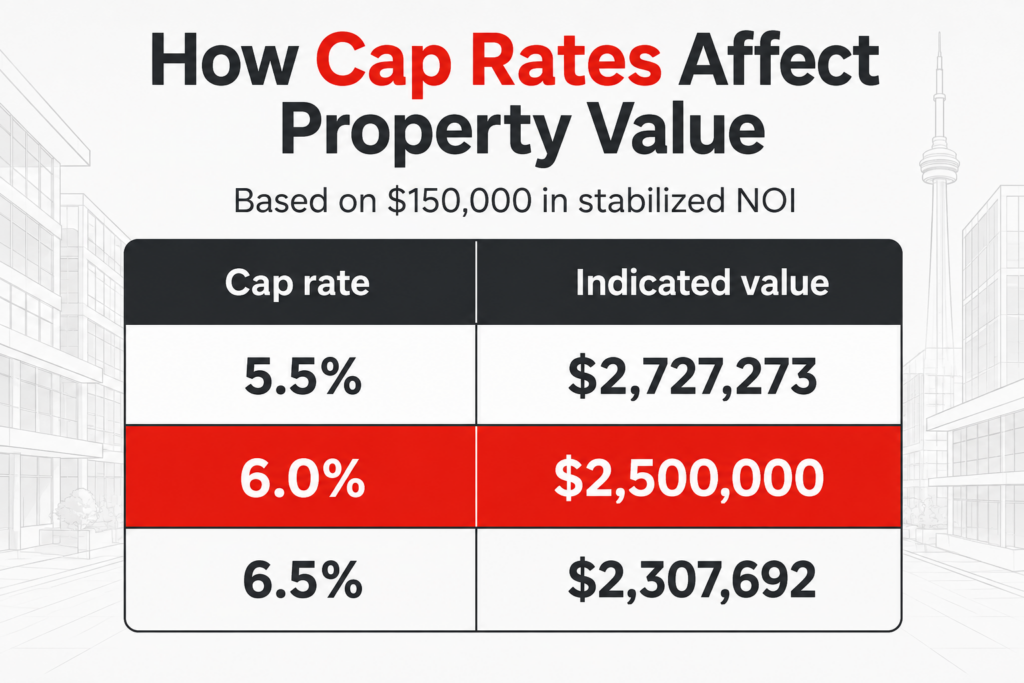
Moving from a 5.5% to a 6.5% cap rate changes the indicated value by approximately $419,581, even though the NOI has not changed.
The appropriate cap rate can be affected by:
- Property type and location
- Building condition
- Lease duration
- Tenant creditworthiness
- Vacancy and rollover risk
- Expected income growth
- Comparable sales
- Financing and investment-market conditions
There is no single commercial property cap rate in Ontario or the GTA.
For context, CBRE Canada reported a national average all-properties cap rate of 6.58% in Q2 2026. This is a broad Canadian indicator and should not be applied directly to an individual GTA property.
Colliers Canada reported an average cap rate of 4.64% for GTA multifamily transactions in Q2 2026. That figure applies to a particular transaction dataset, not to retail, industrial or office properties.
These benchmarks demonstrate why the appraiser must use evidence relevant to the property’s asset class, location, quality and valuation date.
Common Reasons a Commercial Appraisal Comes in Low
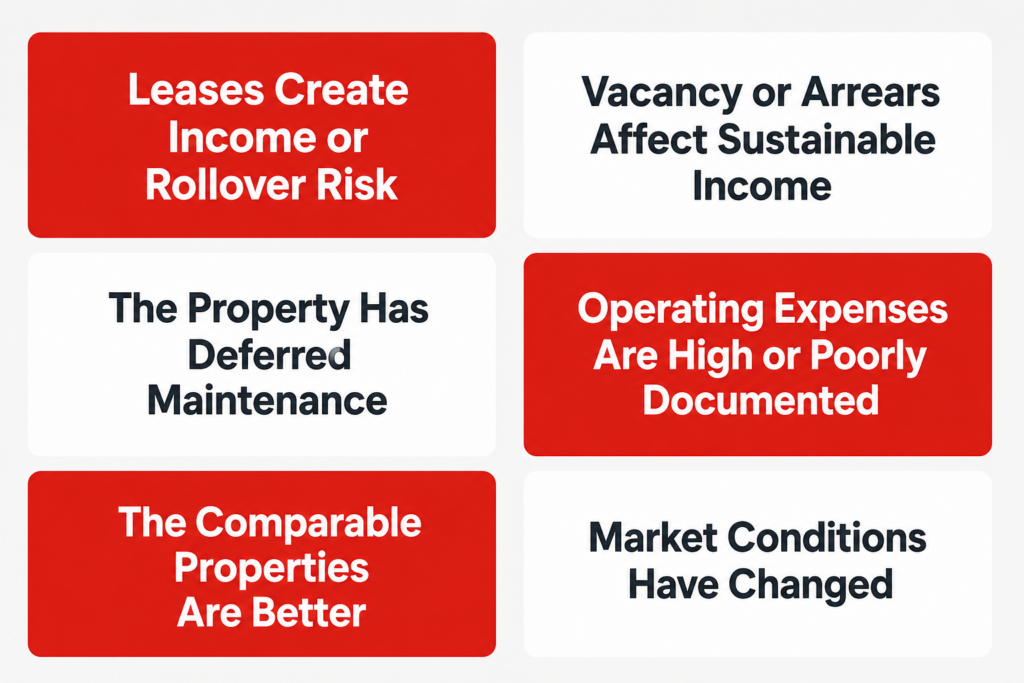
Leases Create Income or Rollover Risk
Below-market rent may limit current income. Above-market rent approaching expiry may be difficult to maintain. Short leases or several leases expiring around the same time can also create vacancy, commission and tenant-improvement risks.
Vacancy or Arrears Affect Sustainable Income
Current occupancy does not always represent future performance. Chronic arrears, tenant concentration or an upcoming vacancy can reduce the income an appraiser considers sustainable.
The Property Has Deferred Maintenance
An aging roof, outdated HVAC system, damaged parking lot or obsolete layout may affect expected costs and tenant demand. The precise value effect depends on the severity of the issue and how the appraiser treats it.
Consistent property maintenance can help owners address avoidable condition problems and maintain records of completed work.
Operating Expenses Are High or Poorly Documented
High operating costs reduce NOI. In other cases, weak accounting records make it difficult to separate normal operating expenses from one-time repairs, capital expenditures or owner-related costs.
The Comparable Properties Are Better
A comparable property may have better access, parking, visibility, condition, tenants or lease terms. Appraisers account for these differences rather than relying on the sale price alone.
Market Conditions Have Changed
Commercial values respond to financing costs, investor return requirements and leasing conditions. A sale or appraisal completed several years ago may no longer reflect the current market.
How to Prepare for a Commercial Property Appraisal
You should not pressure an independent appraiser toward a target value. Instead, provide complete and accurate information that allows the property to be assessed fairly.
Before the appraisal:
- Prepare a current rent roll. Include leased area, rent, lease dates, renewal options, arrears and expense-recovery terms.
- Provide all signed leases and amendments. Do not present an unsigned proposal as a completed lease.
- Organize financial statements. Include two or three years of operating results, trailing-12-month figures and the current budget.
- Explain unusual expenses. Identify one-time repairs, capital expenditures and owner-related costs.
- Document major improvements. Provide invoices and completion dates for roofing, paving, HVAC and other capital work.
- Address reasonable maintenance issues. Correct visible problems where practical, but do not conceal defects or complete unnecessary work simply for the inspection.
- Provide relevant property information. Include surveys, floor plans, environmental reports, zoning information and reliable comparable sales.
A concise, organized appraisal package is more useful than sending a large collection of unexplained documents.
Can You Challenge a Commercial Appraisal in Canada?
A low conclusion does not automatically mean the appraisal is wrong. However, a review may be appropriate if you identify:
- Incorrect building or land area
- Incorrect lease terms
- Missing lease amendments
- NOI calculation errors
- A recent, relevant comparable sale that was omitted
- Reliance on a materially unsuitable comparable
- Assumptions contradicted by reliable property records
If a lender ordered the appraisal, the lender is commonly the appraiser’s client. Submit a concise written request to the lender or mortgage broker, supported by documents.
That is more persuasive than stating that an owner or broker believes the property should be worth more.
Depending on the purpose of the valuation, owners may also seek an independent property evaluation. Before doing so, confirm whether the intended user requires a formal appraisal and which professional qualifications it will accept.
Prepare Your Commercial Property for Its Full, Supportable Value
Occupancy, operating expenses, tenant quality, financial reporting and building condition are long-term value drivers, not last-minute appraisal tricks.
Professional commercial property management can help owners strengthen these fundamentals and maintain the records needed for refinancing, acquisitions and future appraisals.
Frequently Asked Questions
- What is a cap rate?
A cap rate is the relationship between a property’s stabilized NOI and its price or value. Under direct capitalization, value equals NOI divided by the cap rate. A higher cap rate produces a lower value when NOI remains unchanged.
- Why did my commercial appraisal come in lower than expected?
Possible reasons include a lower stabilized NOI, vacancy or collection loss, lease-expiry risk, high operating expenses, deferred maintenance, stronger comparable properties or a higher market-supported cap rate.
- Can I challenge a commercial property appraisal?
If your lender arranged the appraisal and you find an error, contact the lender or your mortgage broker. Provide documents supporting the correction, such as an updated lease, survey or financial statement. The lender can then ask the appraiser to review the information, although this does not guarantee that the appraised value will change.
- Does professional property management increase appraised value?
It can improve the factors that support value, including collections, occupancy, expense control, lease documentation and building condition. However, professional management does not automatically guarantee a lower cap rate or higher appraisal.
- What documents should I provide for a commercial property appraisal?
Prepare a current rent roll, signed leases and amendments, two or three years of operating statements, the current budget and records of major repairs or capital improvements. Complete and accurate documentation helps the appraiser understand the property’s income, expenses, tenancy and condition.