
If you signed your commercial mortgage in 2020 or 2021, here’s the uncomfortable truth: the building that qualified easily back then may not qualify on the same terms today. Not because a tenant left. Not because you missed a payment. Simply because the math changed underneath you.
Rates repriced sharply between 2022 and 2024, cap rates expanded, and lenders tightened how they look at net operating income, debt coverage, and vacancy. The Bank of Canada has held its policy rate at 2.25% for most of the past year, but that hasn’t brought five-year money back to pandemic-era levels. Fixed commercial rates follow bond yields, and in its September decision, the Bank itself flagged long-term yields moving up in Canada and globally.
For GTA owners with a maturity coming up in the next 12 to 18 months, the real challenge is the gap between the value your lender assumed when you borrowed, and the value a current appraisal will support today. This guide walks you through how refinancing commercial property in Ontario actually works right now, what lenders want to see on their desk, and what your options are if the numbers come up short.
How Commercial Mortgage Underwriting Works in 2026
Your lender cares less about you and more about whether the building can carry its own debt, and three numbers decide that.
This is the biggest mindset shift for owners coming from residential lending. In commercial real estate lending in Canada, the property’s income is the borrower that matters most. Your personal income still counts, but it’s a supporting actor. The lead roles go to Net Operating Income (NOI), Debt Service Coverage Ratio (DSCR), and Loan-to-Value (LTV).
Net Operating Income (NOI)
NOI is your gross rental income minus operating expenses: property taxes, insurance, maintenance, management fees, and any utilities you pay as landlord. Mortgage payments are not included.
Here’s the part many owners miss. The appraiser won’t simply accept the NOI on your statements. They’ll normalize it. If your vacancy allowance is below the market’s historical average, they’ll raise it. If you self-manage and show zero management fees, they’ll add a market-rate fee anyway. If the roof is overdue and you haven’t budgeted a reserve, expect a deduction. Understanding how commercial property is actually valued before the appraiser walks in lets you spot these haircuts coming instead of discovering them in the commitment letter.
Debt Service Coverage Ratio (DSCR)
DSCR is NOI divided by your total annual debt service (principal plus interest). Most Canadian commercial lenders want a minimum of 1.20x to 1.25x, meaning NOI must be at least 20% to 25% higher than your annual payments. In today’s environment, many lenders are quietly underwriting to 1.30x or 1.35x to cushion against rate volatility.
To see why this matters so much right now, take a simple illustrative example: a GTA property producing $600,000 in NOI, with about $6.0 million left on its mortgage at renewal.
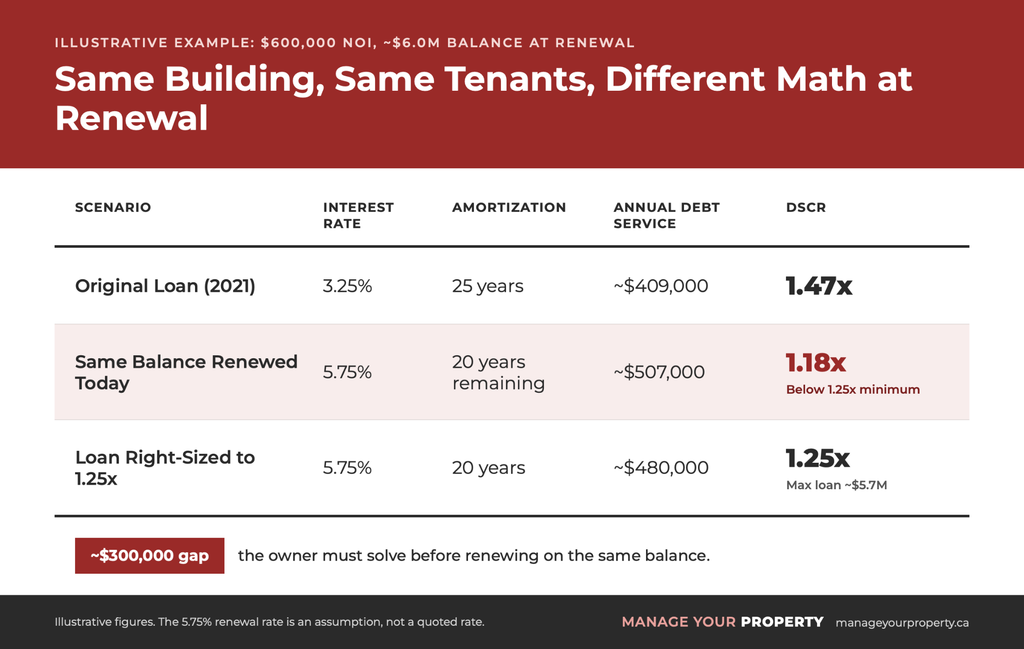
Same building, same tenants, same rent. Yet at renewal, the property can only support roughly $5.7 million of debt, leaving a $300,000 gap the owner has to solve. A property below 1.20x may be offered a smaller loan, asked for additional security, or declined altogether.
Loan-to-Value (LTV)
Most commercial lenders now cap loans at 65% to 75% of appraised value, down from as high as 80% in many pre-2022 deals. For office, some lenders have pulled back to 60% given lingering questions about remote work and valuations.
LTV gets squeezed from both sides when cap rates expand. That same $600,000 of NOI is worth $12 million at a 5.0% cap rate, but only $10 million at 6.0%. At 75% of $12 million, you could borrow $9 million. At 65% of $10 million, the ceiling drops to $6.5 million. In our example, LTV isn’t the binding constraint; coverage is. For many owners, though, it’s both at once.
The good news? The data lenders use to judge all three metrics comes straight from your financial records. When you know how to read your commercial property management report, you can track your NOI and DSCR month by month and walk into renewal already knowing where you stand.
The Current Lending Landscape for GTA Commercial Properties
Lenders are still lending in the GTA, but they’re choosier about what, to whom, and on what terms.
If your last commercial mortgage renewal in Ontario happened in 2019 to 2021, here’s what’s different this time around:
- Payment Shock Is Real: Five-year fixed commercial rates are materially higher than terms written in 2019 to 2021. Even with prime holding at 4.45% through 2026, renewing borrowers are facing payments 20% to 30% higher on the same balance.
- Vacancy Gets Stress-Tested: Lenders are applying higher vacancy assumptions than they did last cycle, especially for office and retail, so a building that’s 95% leased today may be underwritten as if it were 90%.
- CMHC Is Still the Best Door for Apartments: CMHC’s MLI Select program remains available for multi-residential properties, rewarding affordability, accessibility, and energy efficiency with higher leverage and longer amortizations. It’s powerful, but highly property-specific.
- Alternative Lenders Fill the Gaps: Mortgage investment corporations (MICs) and private funds are more active in GTA commercial property refinancing, offering higher LTVs and looser underwriting in exchange for higher rates. Useful as a bridge, rarely a long-term home.
- Who Manages the Building Matters More: Lenders are weighing borrower experience, property management quality, and tenant credit more heavily than in the previous cycle.
Two items that often catch owners off guard: environmental reports and tenant arrears. Most lenders will ask about environmental liability for commercial landlords, and a Phase I environmental site assessment dated within the last 12 to 18 months is standard. Meanwhile, any tenant behind on rent becomes a question mark on your income. Having a clear commercial rent arrears escalation ladder for Ontario landlords shows the lender that arrears are being handled, not ignored.
Office vs. Retail vs. Industrial vs. Multi-Residential
Lender appetite varies sharply by asset class, so knowing where your property sits on the spectrum saves you weeks of shopping.
- Industrial: Still the lender favourite. GTA industrial vacancy held at about 4.1% in Q1 2026, with availability at 5.8%, and rents remain well above pre-2020 levels even after easing.
- Well-Leased Retail: Grocery-anchored and necessity retail with strong covenants is getting relatively good terms.
- Multi-Residential: The deepest lender pool of any asset class, with CMHC-insured options for qualifying buildings.
- Office: The toughest file. GTA office vacancy dipped to 16.4% in Q1 2026, its first decline since the pandemic, but that’s still elevated. Class B suburban office faces the most restrictive underwriting: extra equity, shorter amortizations, or a flat no from some lenders.
If you own office or mixed-use space, start lender conversations earlier than you think you need to. The lender pool is thinner, and the ones still active will want a stronger file.

What Lenders Need: Documentation for a Commercial Refinance
A strong refinance package proves three things: the property is professionally run, its income is stable and verifiable, and you understand your asset.
Financial Documentation
This is the core of your file, and it’s what the commercial property appraisal in Ontario will lean on most heavily:
- Operating Statements: Two to three years of detailed income and expense statements. Tax returns alone won’t cut it.
- Current Rent Roll: Tenant names, leased area, lease start and expiry dates, base rent and escalation schedules.
- Leases and Amendments: Every lease, plus side letters, amendments, and renewal options. Lenders read the fine print.
- Proof of Rent Collection: Bank statements showing rent deposits, or property management trust account statements.
- Accounts Receivable Aging: A current snapshot of who’s paid and who hasn’t. This is where your DSCR story either holds or cracks.
Compliance and Third-Party Reports
Lenders want to know the building won’t surprise them with a liability after funding:
- Environmental Site Assessment: A Phase I dated within 12 to 18 months, and a Phase II if the Phase I flags anything.
- Elevator Certificates: A current operating certificate from the Technical Standards and Safety Authority (TSSA)for buildings with elevating devices.
- Fire and Electrical Records: An up-to-date fire safety plan and compliance records from Ontario’s Electrical Safety Authority (not to be confused with an environmental site assessment, despite the shared acronym).
Property Management Quality
Here’s something lenders won’t always say out loud: they trust some NOI more than others.
A property with a professional manager producing clean monthly statements, documented maintenance records, and an accurate rent roll gets better treatment in underwriting than a self-managed building with records spread across email threads and spreadsheets. It’s not just a paperwork point. It shapes how confident the lender feels that today’s income will still be there in year three of the term.
That’s exactly where commercial property management earns its keep at refinancing time. Pair it with professional accounting and bookkeeping and your financials are audit-ready for both the lender and the CRA, without a last-minute scramble.
Strategies for Owners Facing a Shortfall at Renewal
A shortfall at renewal is a problem to solve, not a verdict, and you have more options than most owners realize.
Tighten Your NOI Before You Apply
The cheapest fix is often inside the building. Collecting outstanding arrears, recovering operating costs you’re entitled to under your leases, re-tendering service contracts, and filling vacant units all lift NOI before the appraiser runs the numbers. Using our earlier example, adding just $25,000 a year to NOI moves the DSCR from 1.18x to about 1.23x. Owners often ask how much commercial property management costs in the GTA; at refinancing, the better question is how much NOI professional management can protect or add.
Inject Additional Equity
If your LTV or DSCR is out of range, paying the balance down to the lender’s maximum may unlock a renewal on acceptable terms. It takes capital, but it avoids the cost and disruption of a sale or an expensive bridge loan.
Negotiate With Your Existing Lender
Your current lender often prefers a modified renewal to the cost and uncertainty of enforcement. A well-documented property, a professional management team, and a clear plan to close any NOI gap put you in a far stronger position to negotiate a term extension, a longer amortization, or modest LTV relief.
Bridge to Value-Add
If your property has real upside, such as vacant space to lease up, below-market rents rolling over, or capital improvements that will lift income, a short-term bridge loan from an alternative lender can buy you time. Bridge pricing typically runs prime plus 3% to 6%, which works out to roughly 7.45% to 10.45% with prime at 4.45%. Expensive, yes, but it can make sense for a 12- to 24-month hold while the income profile improves enough to qualify for institutional terms.
Partial Sale or Joint Venture
Bringing in a joint venture partner or selling a partial interest can recapitalize the property without a full sale. This works well for owners with significant equity who need to free up capital while keeping a stake in an asset with long-term upside.
Walk Into Your Renewal Ready, Not Rushed
The owners who get the best terms in a repriced market aren’t always the ones with the best buildings. They’re the ones whose numbers are clean, whose tenants are documented, and whose files are ready the moment a lender asks.
That’s what we do. Our commercial property management service keeps your rent roll, leases, compliance records, and monthly financials organized and lender-ready, so your next refinance starts from a position of strength. Need your books in shape first? Our accounting and bookkeeping team builds audit-ready records for lenders and the CRA alike. And if you hold several assets, our property management for real estate investors gives you portfolio-level visibility on NOI and debt coverage.
We work with commercial owners right across the region, from Toronto, North York and Etobicoke to Mississauga, Brampton, Vaughan, Markham, Oakville and Oshawa.
Mortgage maturing in the next 12 months? Book a consultation with our team, and we’ll help you get your property’s financials refinance-ready before your lender asks for them.
Frequently Asked Questions
1. How Far in Advance Should I Start the Commercial Mortgage Renewal Process?
Ideally six to 12 months before your maturity date. That gives you time to gather documents, order a current appraisal, approach several lenders, and negotiate without the clock forcing your hand. Commercial mortgages don’t roll over as easily as residential ones, and a matured loan with no replacement in place can trigger default provisions.
2. What Is a Typical Commercial Mortgage Term in Canada in 2026?
Most are written with five-year terms and 20- to 25-year amortizations. Three-year terms are available and may appeal if you expect rates to fall before your next renewal, while 10-year terms are offered for well-leased, institutional-quality assets. Keep in mind that a shorter amortization raises your annual debt service, so you’ll need more NOI to hit the same DSCR.
3. Does My Property’s MPAC Assessment Affect My Commercial Mortgage Refinancing?
Indirectly, yes. Your MPAC assessment drives your property tax, which is an operating expense that reduces NOI. A big tax increase that isn’t fully recoverable from tenants under a triple net lease will lower the DSCR your lender calculates. Knowing your current and projected assessment is part of preparing for refinancing.
4. Can I Refinance a Commercial Property With a Holdover Tenant?
Yes, but it complicates the file. A tenant in holdover has no lease certainty, so lenders may treat that income as higher-risk, ask for proof of ongoing lease negotiations, or discount it in their NOI analysis. Resolving the holdover before you submit, either with a new lease or a formal termination, strengthens your application.
5. What Credit Score or Net Worth Do I Need for a Commercial Mortgage?
Qualification is driven mainly by the property’s NOI, not your credit score, but your financial strength still matters, especially on smaller properties where personal guarantees are common. Lenders will review your credit, your net worth relative to the loan, and your experience owning commercial real estate. Institutional lenders typically look for meaningful real estate experience and, on smaller deals, a net worth at least equal to the loan amount.