A tenant runs an auto shop on your property for eight years, pays rent on time, and leaves. Two years later, a buyer’s lender orders a Phase I environmental site assessment, the consultant flags the old service bays, and soil sampling confirms petroleum contamination. The tenant is long gone. The cleanup bill is yours.
This isn’t a rare scenario. Environmental liability is one of the most underestimated risks a commercial landlord in Ontario can face. Unlike a leaky roof or a tired HVAC system, contamination can make a property unsellable, sink a refinancing, and produce cleanup costs that exceed what the property is worth. And under Ontario law, you don’t need to have caused the problem to be on the hook for it.
This guide walks you through how environmental liability works in Ontario, when you need a Phase I or Phase II environmental site assessment (ESA), what each one realistically costs in the GTA, and the practical steps we recommend to keep your exposure under control.
Environmental Liability Under Ontario Law
Ontario’s rules put the burden on whoever owns or controls the land, not just whoever made the mess.
Who Can Be Held Responsible
The Environmental Protection Act (EPA) gives the Ministry of the Environment, Conservation and Parks (MECP) broad power to order cleanup. Those orders can be issued to current owners, former owners, occupants, and anyone who had charge, management, or control of a property, regardless of who actually caused the discharge. In practice, this means fault isn’t the deciding factor. Ownership often is.
That’s why the MECP can direct a current owner to remediate contamination left by a previous owner or a former tenant. Lenders generally have statutory protections, but those protections can narrow when a lender takes possession or control of a property through foreclosure or power of sale.
What Triggers Environmental Liability
- Ownership or Control: Owning or managing a property where a contaminant has been discharged into the environment.
- Causing or Permitting a Discharge: Allowing a discharge to happen, even if you didn’t know about it at the time.
- Inheriting Contamination Through a Transfer: Acquiring a property where contamination already exists.
- Lender Exposure: Taking possession or control of a property through enforcement in certain circumstances.
Where Contamination Usually Comes From
Most contamination on GTA commercial properties traces back to a handful of familiar sources:
- Underground Storage Tanks (USTs): Old heating oil or fuel tanks that corrode and leak over decades. Fuel storage is regulated by the Technical Standards and Safety Authority, and abandoned or unregistered tanks are a common Phase I red flag.
- Dry Cleaning Solvents: PCE and TCE are persistent, travel through groundwater, and are expensive to clean up.
- Auto Service and Repair Operations: Waste oil, solvents, and hydraulic fluids from service bays and hoists.
- Industrial and Manufacturing Uses: Metals, chemicals, and process residues.
- Legacy Land Uses: Activities from decades ago, before modern environmental standards existed.
If any of these show up anywhere in a property’s history, assume elevated risk, even if today’s tenant is an accounting firm.
Phase I Environmental Site Assessment: Your First Line of Defence
A Phase I ESA tells you whether there’s reason to worry before you spend serious money finding out.
What a Phase I ESA Includes
A Phase I is a records review and site inspection designed to identify recognized environmental conditions (RECs), meaning signs that a property may have been affected by hazardous substances or petroleum products. No soil or groundwater is sampled. A standard Phase I covers:
- Historical Land Use Review: Aerial photographs, fire insurance plans, city directories, and historical maps.
- Government Database Searches: Known spills, contaminated sites, registered fuel tanks and environmental permits on or near the property.
- Regulatory Records Review: Any MECP orders or existing Records of Site Condition tied to the property.
- Site Visit: A visual inspection for staining, odours, vent pipes, drums, and other warning signs.
- Interviews: Conversations with current owners and occupants about past uses and known issues.
- Written Report: A summary of RECs, controlled RECs (CRECs), and historical RECs (HRECs), with a recommendation on whether further investigation is needed.
CSA Phase I vs. Regulatory Phase One: Know Which One You’re Buying
This is where many landlords get caught. Most lenders ask for a Phase I prepared to the CSA Z768-01 standard, which is designed for transactions and financing. A regulatory “Phase One” prepared under Ontario Regulation 153/04 is a different product. A Phase One completed under the regulation is more comprehensive than a typical CSA-style Phase I, and it is the assessment that must precede a Record of Site Condition filing.
If there’s any chance you’ll redevelop, convert, or file a Record of Site Condition down the road, ask your consultant up front whether a regulatory Phase One makes more sense. Paying once for the right report is cheaper than paying twice.
When You Need a Phase I
- Buying a Commercial Property: Virtually every institutional lender requires a Phase I as a condition of financing.
- Refinancing: Many lenders require a current Phase I before renewing or replacing a mortgage. If you’re refinancing a commercial property in a repriced market, an environmental surprise is the last thing you want delaying your closing.
- Higher-Risk Tenant Use Changes: Leasing to an automotive, industrial, or chemical user changes your risk profile overnight.
- Before a Record of Site Condition: A regulatory Phase One is a required step.
- Selling to a Financed Buyer: Your buyer’s lender will want one, so having a recent report ready can keep your deal on schedule.
Phase I ESA Cost in Ontario
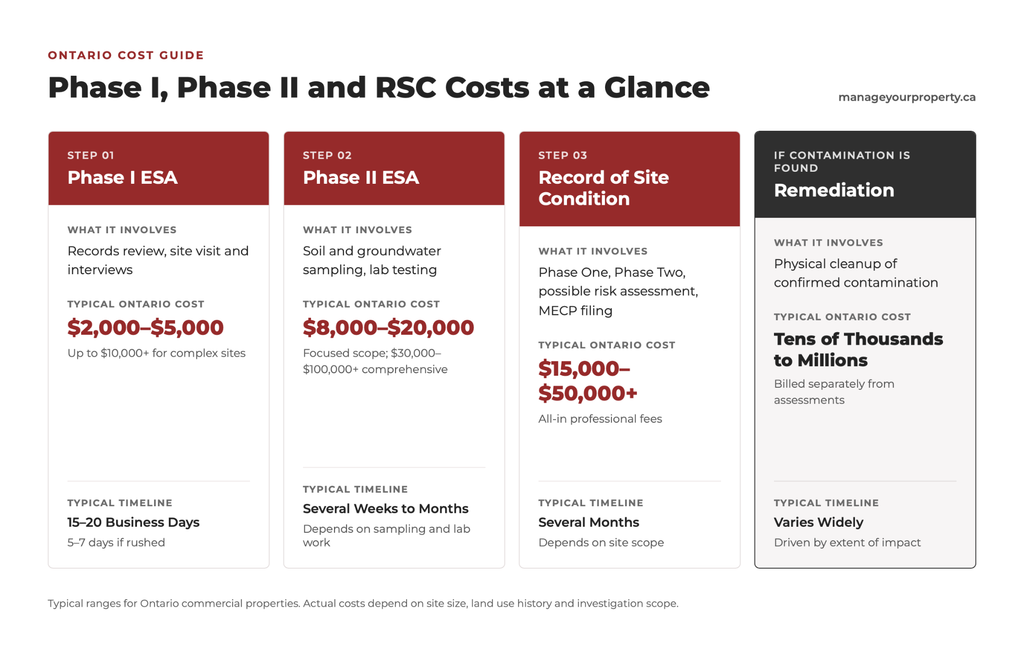
For a standard commercial property, Phase I ESA fees in Ontario typically run $2,000 to $5,000, depending on property size, the complexity of past uses, and the consulting firm. Rush turnaround of 5 to 7 business days, instead of the usual 15 to 20, can add 20% to 40% to the fee. Properties with complex histories, multiple parcels, or heavy industrial use can reach $5,000 to $10,000 or more.

Phase II Environmental Site Assessment: When the Paper Trail Isn’t Enough
If a Phase I flags a concern, a Phase II answers the only question that matters: is contamination actually there?
What a Phase II ESA Includes
Unlike a Phase I, a Phase II involves physical sampling and lab work:
- Investigation Work Plan: A site-specific plan built around the Phase I findings.
- Soil Borings: Drilled at targeted locations, such as near former tanks, service bays, or loading areas.
- Groundwater Monitoring Wells: Installed where contaminants may have migrated.
- Accredited Laboratory Analysis: Testing for the contaminants of concern, such as petroleum hydrocarbons, chlorinated solvents, or heavy metals.
- Comparison to Provincial Standards: Results are measured against the applicable site condition standards under O. Reg. 153/04.
- Written Report: Confirms whether contamination is present and, if so, how much and how far it extends.
Phase II ESA Cost in Ontario
Phase II costs depend on the number of sample locations, drilling depth, the contaminants being tested, and lab turnaround times. A focused Phase II on a smaller commercial property with limited concerns may cost $8,000 to $20,000. A comprehensive investigation on a large site with a complicated history can run $30,000 to $100,000 or more.
Keep in mind that remediation is a separate bill entirely. If contamination is confirmed, cleanup can range from tens of thousands of dollars to several million.
What Happens to the Deal If Contamination Is Confirmed
A positive Phase II doesn’t automatically kill a transaction, but the liability has to be priced or managed. Common approaches include:
- Price Reduction: The purchase price drops to reflect estimated cleanup costs.
- Seller-Funded Remediation: The seller cleans up the site before closing.
- Environmental Holdback or Escrow: A portion of the purchase price is held back to cover remediation.
- Representations, Warranties and Indemnities: The seller takes on contractual responsibility for cleanup, sometimes backed by a full indemnity.
Confirmed contamination also affects value long after closing, which is worth understanding if you want to know how commercial property is actually valued. How you handle these findings is a negotiation, and it requires legal advice specific to your deal.
Record of Site Condition (RSC) in Ontario
A Record of Site Condition is the province’s official stamp confirming that a property meets the standards for a particular use.
When an RSC Is Required
An RSC is filed in the MECP’s Environmental Site Registry and certifies that a property meets Ontario’s site condition standards for its intended use. It’s typically required when:
- Changing to a More Sensitive Use: Converting industrial or commercial land to residential, institutional, or parkland use under O. Reg. 153/04.
- A Municipality or Approval Body Requires It: For example, as a condition of a development approval.
- A Contract Requires It: Some purchase or financing agreements make an RSC a condition.
According to the province, filing an RSC in the Environmental Site Registry can reduce potential liability for property owners. You can read more on the MECP’s brownfields redevelopment page.
What Changed in October 2025
If you’re holding out an RSC as a voluntary liability shield, the rules have shifted. Ontario amended O. Reg. 153/04 to prohibit RSC submissions in specified low-risk circumstances and to widen an exemption for certain building use changes to mixed use, with the changes taking effect in October 2025. Owners can generally no longer file an RSC that wasn’t otherwise required and was prepared only on the basis of a Phase One ESA, subject to limited exceptions.
For GTA landlords eyeing office-to-mixed-use conversions, the expanded exemption could be good news. For anyone planning a voluntary “clean bill of health” filing, check with your QP first. The full decision is posted on the Environmental Registry of Ontario.
RSC Cost
Preparing an RSC requires a Qualified Person, a regulatory Phase One and Phase Two, a risk assessment in some cases, and the MECP filing fee. All-in professional fees typically range from $15,000 to $50,000+, depending on site complexity and whether a risk assessment is needed.
How Commercial Landlords Manage Environmental Risk
Environmental liability doesn’t have to be a crisis if you build the right habits into how you buy, lease, and operate.
Before You Buy
- Order a Phase I on Every Acquisition: Not just when your lender requires it. It’s a few thousand dollars against a potentially six- or seven-figure risk.
- Negotiate Environmental Protections: Include representations and warranties in the agreement of purchase and sale, and push for holdbacks or indemnities when RECs are flagged.
In Your Leases
- Restrict Hazardous Uses: Prohibit tenants from storing or using hazardous materials without your prior written consent.
- Require Immediate Spill Notification: Tenants should notify you immediately of any spill, release, or regulatory contact. Spills that may cause adverse effects must also be reported to Ontario’s Spills Action Centre.
- Include a Restoration Clause: Require tenants to remediate any contamination they cause before the lease ends.
- Watch Use Changes at Renewal and Expiry: Tenant transitions are when environmental issues tend to surface. The same discipline applies when dealing with holdover tenants in commercial space, where an undocumented change of use can create risk you never agreed to.
During Ownership
- Refresh Your Phase I at Refinancing: It identifies new conditions that emerged during the lease term.
- Track Compliance Alongside Other Building Obligations: Environmental items belong on the same calendar as your fire, electrical, and elevator obligations. Our commercial building compliance checklist covers how these pieces fit together during an acquisition or renovation.
- Make It Visible in Your Reporting: Tenant use monitoring and environmental compliance should appear in your monthly owner reports. If you’re not sure what to look for, here’s how to read your commercial property management report.
- Know What Your Manager Is Responsible For: Your property manager should be flagging tenant use changes and compliance gaps before they become problems. Learn more about a property management company’s legal responsibilities in Ontario.
Protect Your Property Before It Becomes a Liability
Environmental liability is easiest to manage before it shows up in a lender’s report or a buyer’s due diligence. The landlords who avoid costly surprises are the ones who know what their tenants are doing, keep their leases tight, and catch use changes early.
That’s where we come in. Our commercial property management service includes oversight of tenant use obligations, lease compliance, and coordination with environmental professionals when issues arise. If you’re building a portfolio, our property management for real estate investors keeps every asset on the same disciplined footing, and our accounting and bookkeeping service makes sure assessment, remediation, and holdback costs are tracked cleanly for lenders and tax time.
We work with commercial landlords across the GTA, from Toronto and Mississauga to Vaughan, Markham, Brampton, Oakville, and Oshawa. Contact us today to talk about how we can help protect your property and your bottom line.
Frequently Asked Questions
1. Is a Phase I ESA Required by Law for All Commercial Property Purchases in Ontario?
No statute requires a Phase I for every commercial purchase. However, virtually all institutional lenders require one as a condition of financing, and a regulatory Phase I is required before filing a Record of Site Condition. If you’re financing through a bank, credit union, or institutional lender, expect to need one. Experienced buyers paying cash usually order one anyway for their own protection.
2. How Long Is a Phase I ESA Valid?
For a Record of Site Condition, the MECP says a Phase One report needs to be updated if 18 months or more have passed since the last records review, interviews, and site reconnaissance were completed. Lenders set their own rules, often 6 to 12 months for refinancing and 12 to 18 months for acquisitions. If your report is older than your lender’s threshold, plan for an update.
3. What Is the Difference Between a Qualified Person and an Environmental Consultant?
A Qualified Person (QP) meets the criteria set out in section 5 of O. Reg. 153/04 and is authorized to prepare regulatory Phase One and Phase Two ESAs and RSCs. QPs are generally licensed professional engineers or professional geoscientists with environmental expertise. Not every environmental consultant qualifies, so for any regulatory work, confirm your consultant’s licence through Professional Engineers Ontario or the Professional Geoscientists Ontario directory.
4. Can I Be Held Liable for Contamination Caused by a Previous Tenant?
Yes. If a tenant contaminates your property and can’t or won’t pay for the cleanup, the MECP can order you, as the owner, to remediate. That’s exactly why lease clauses covering permitted use, hazardous materials, spill notification, and restoration obligations matter so much.
5. What Does a Phase I Cost in the GTA vs. Smaller Ontario Markets?
GTA Phase I fees tend to run slightly higher because of consultant rates and the complexity of historic urban land uses. A standard GTA commercial Phase I typically falls between $2,500 and $5,000. Rural or smaller-market properties with simpler histories may come in between $1,800 and $3,500.
6. Do I Need Environmental Insurance in Addition to a Phase I ESA?
A Phase I identifies risk. It doesn’t insure against it. Environmental pollution liability (EPL) insurance can cover remediation costs, third-party bodily injury and property damage claims, and legal defence costs. For higher-risk properties such as former gas stations, dry cleaners, or industrial sites, it’s worth pricing EPL coverage alongside your Phase I.