
Most commercial property owners receive a monthly statement from their property manager and can’t tell whether it contains everything they should be seeing. Some get a one-page rent roll summary and a bank transfer. Others receive a 40-page PDF packed with raw numbers but no budget baseline to measure them against. Neither tells you what you actually need to know: is this asset performing as it should, and are the people managing it doing their job?
The commercial property operating budget is the financial infrastructure that answers those questions. This article defines exactly what a monthly commercial property financial report should contain, what each component tells you about the health of your investment, and the specific red flags that signal your property manager’s reporting is falling short – and by how much.
If you’re also navigating commercial financing, keep in mind that the same T12 operating statements your lender requests at underwriting and renewal are built directly from this monthly reporting. Our article on commercial mortgages in Canada: how they differ from residential covers exactly what lenders are looking for in those documents.
What a Commercial Operating Budget Actually Is
The operating budget is the annual financial plan for your property: projected income by source (base rent, additional rent, parking, storage), projected operating expenses by category, and the resulting projected Net Operating Income (NOI). It’s set at the beginning of each fiscal year and becomes the benchmark against which actual monthly performance is measured.
This is the element most missing from inadequate monthly reports: a budget-vs-actual column. Without it, a monthly number telling you that utilities cost $8,400 this month is uninterpretable. Was that $2,000 over budget? Exactly in line? The number alone tells you nothing. Our accounting and bookkeeping service produces budget-vs-actual reporting as a standard monthly deliverable – which is also why our clients are rarely surprised at year-end reconciliation time.
If you’re newer to commercial property ownership and the accounting discipline that comes with it, our landlord’s guide to rental property accounting and bookkeeping is a useful primer on the record-keeping infrastructure that supports professional property management at any scale.
Operating Budget vs Capital Budget – an Important Distinction
The operating budget covers recurring expenses: utilities, cleaning, landscaping, snow removal, insurance, property taxes, routine maintenance, management fees. The capital budget covers non-recurring investments: roof replacement, HVAC systems, elevator upgrades, parking lot resurfacing, lobby renovation.
Capital items must not appear in the operating budget as current-period expenses. They are funded from reserves or separate financing and affect the property’s capital structure – not its operating cash flow. When a property manager expenses a roof replacement as a maintenance line item, it artificially inflates operating costs, depresses NOI, and misrepresents the property’s actual operating performance. Watch for this.
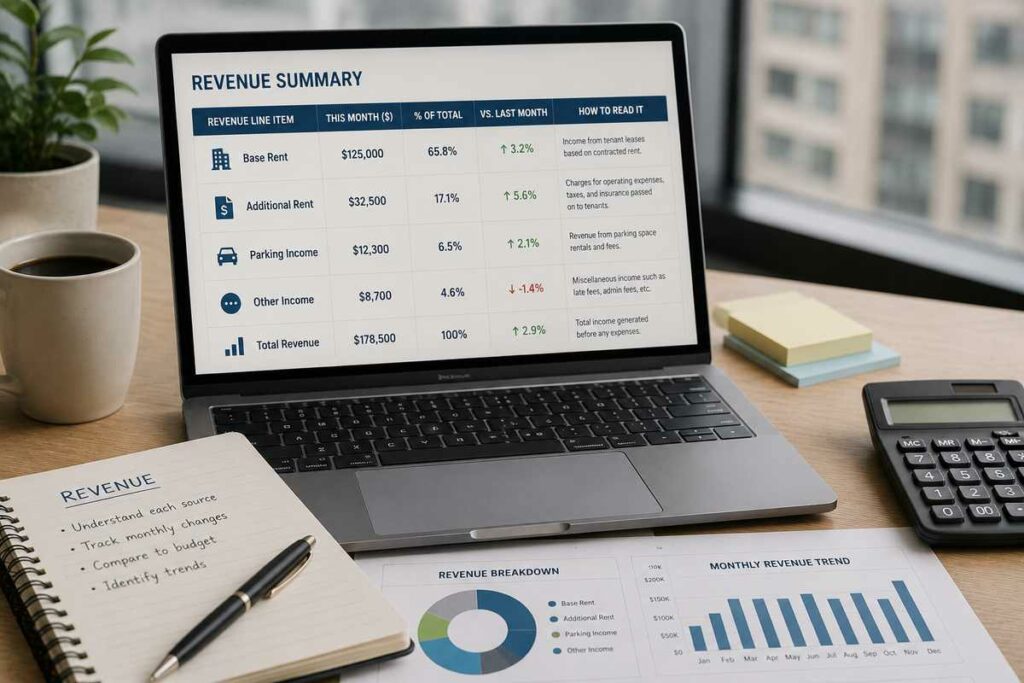
Revenue Section: Every Line Item and How to Read It
Base Rent – Never a Single Total
The revenue section must show base rent charged, collected, and in arrears by tenant – not a single aggregated number. A report that shows “Total Rent Collected: $47,200” gives you no information about which tenant is delinquent, by how much, or for how long. Our professional rent collection service produces tenant-by-tenant collection data as a standard component of monthly reporting, because aggregate totals are not useful for active asset management.
Vacancy has a cost that extends well beyond lost rent. Our article on the real cost of losing a tenant in Toronto quantifies that cost in detail – and it’s consistently higher than owners estimate when they account for turnover costs, free rent periods, leasing commissions, and repositioning work.
Additional Rent and Operating Cost Recoveries (TMI)
In net and modified gross leases – the dominant structure for commercial properties – tenants pay a proportionate share of the property’s operating costs as Additional Rent, often called TMI (Taxes, Maintenance, Insurance). This is charged monthly as an estimate based on the budget established at the start of the year. Monthly reports must show: the estimated Additional Rent charged to each tenant, the actual operating costs incurred, and the variance between the two. At year end, the operating cost reconciliation adjusts for the cumulative difference.
Vacancy and Abatements
Every vacant unit must appear as a zero-revenue line on the rent roll – not simply be absent from the report. Rent abatement periods (free rent granted as part of a lease deal) must be disclosed as a separate line showing the abated amount, so the owner can see the economic vacancy even during a period of nominal 100% occupancy.
For context on how vacancy rates affect income in different GTA submarkets, see our analysis of how vacancy rates impact your rental income in Durham Region – the patterns described apply across the GTA commercial market.
Operating Expense Categories: Every Line Your Manager Should Report
Property Taxes
Monthly accrual of the annual property tax bill, actual payments made to the municipality, and the status of any active MPAC assessment appeals. If an appeal is in progress, the monthly report should note the case status and any estimated refund or additional exposure. Unexplained property tax variances versus budget should be flagged – not treated as a footnote.
Property Insurance
Monthly premium accrual against the annual insurance cost, with the annual total shown for reference. Importantly: were coverage limits reviewed at the most recent renewal? Understated replacement value is one of the most common – and most dangerous – gaps in commercial property insurance. Our overview of landlord insurance in Ontario: what coverage you can’t afford to skip covers the critical coverage categories and limits for income property owners.
Utilities
Hydro, gas, water, and common area electricity should each appear as separate lines, each with a budget-vs-actual comparison. A 25% spike in gas costs in a mild October is not background noise – it’s a signal of an equipment problem, a billing error, or waste in the building’s systems. Monthly utility variance explanations are a minimum expectation from a professional manager.
Repairs and Maintenance
Maintenance costs must be itemised by vendor and work order – not aggregated into a single line. Each repair entry should show: vendor name, date, description of work performed, and cost. A monthly report showing “Maintenance: $12,400” with no supporting detail is a red flag, not a report. Our property maintenance service produces a work order register as part of its standard monthly reporting, giving owners full visibility into every dollar spent on repairs.
Property Management Fee
The management fee line must show: the fee rate (typically 3–6% of gross collected revenue for commercial properties), the calculation basis (gross collected or gross billed – they’re different when there are arrears), and the resulting fee amount. Additional fees – leasing commissions, renewal commissions, project management fees – must appear as separate line items, not buried in the management fee. If you want to benchmark what you’re paying against industry standards, our breakdown of average property management fees for rentals in Ontario provides the relevant ranges by property type and service scope.
Need the full picture of what regular inspections contribute to building condition and operating costs? Our property inspection services are the foundation of the capital reserve planning that keeps your operating budget accurate and your building in lender-ready condition.
The NOI Line: The Most Important Number in Your Report
Net Operating Income = Effective Gross Income minus Total Operating Expenses. It sits above debt service and income taxes, making it the measure of the property’s pure operating performance. And it’s the single most important number in commercial real estate because it directly determines your property’s market value:
Value = NOI ÷ Cap Rate
A property generating $300,000 NOI in a 5.5% cap rate market is worth approximately $5.45M. If vacancy increases and operating costs run over budget, pushing NOI down to $250,000, that same property – in that same market – is now worth approximately $4.55M. Every dollar of NOI compression has a cap-rate-multiplied impact on asset value. This is not a rounding error. It’s why the monthly report must show NOI explicitly, prominently, with the budget figure alongside it for comparison.
For a complete explanation of how appraisers apply the cap rate to your NOI and what drives cap rate selection in the GTA in 2026, see our article on how commercial property is actually valued. It covers the income approach in detail, including the worked example of why the appraiser’s NOI is often lower than what owners expect.
NOI is also the figure your lender reviews for DSCR compliance at mortgage renewal. If you’re carrying commercial financing, protecting NOI is not just an asset value question – it’s a covenant compliance question. Our article on commercial mortgages in Canada explains how lenders use NOI and DSCR in their underwriting and renewal analysis.
2026 approximate GTA cap rates for reference: Industrial (4.5–5.5%), Multi-family residential (4.0–5.25%), Neighbourhood retail (5.5–7.0%), Suburban office (7.0–10.0%). A $10,000 improvement in annual NOI on a 6% cap rate asset adds approximately $167,000 of appraised value. Professional property management for real estate investors is how that improvement gets made and sustained.
Year-End Operating Cost Reconciliation
In net and modified gross leases, tenants pay estimated operating costs monthly throughout the year. At year end, the property manager reconciles actual operating costs against the estimates. If actual costs exceeded the estimates, tenants owe the difference as a balancing payment. If actuals were lower, tenants receive a credit or offset against the following year’s estimates.
The reconciliation statement must be itemised and supported by actual invoices – not a single line per expense category. Most Ontario commercial leases give tenants a right to audit the reconciliation, typically within 60–90 days of delivery. A landlord who can’t produce itemised supporting documentation for each expense category is at risk of a successful tenant challenge, and the relationship damage from a surprise large reconciliation – even a legitimate one – is significant. Our accounting and bookkeeping service maintains the invoice-level backup throughout the year so reconciliation becomes a documentation exercise, not a document hunt.
How well the reconciliation goes is also partly a function of how well the tenant was screened before the lease was signed. Our article on how to vet a commercial tenant’s financials before you sign covers what to look for in a commercial tenant’s financial profile – and a tenant with a strong financial position and a realistic understanding of TMI costs is far less likely to dispute a year-end reconciliation.
Reserve Fund Reporting
The reserve fund is the accumulated cash set aside for capital repairs and replacements – the money that funds the roof when it fails, the HVAC when it needs replacement, the parking lot when it needs resurfacing. Monthly reporting must show four things: opening balance, contributions during the month, disbursements from the reserve (for capital items), and the closing balance.
If you don’t see the reserve fund balance on your monthly statement, you have no visibility into one of the most important financial indicators of your property’s long-term health. You don’t know whether the fund is adequately capitalised for the building’s age and condition. You don’t know whether capital items are being funded correctly from reserves rather than expensed incorrectly against operations. You don’t know if the reserve has been accessed improperly. Our property inspection services and property evaluations service provide the building condition assessment that should underpin reserve fund sizing – the reserve contribution rate should reflect actual building age, condition, and capital expenditure forecast, not a flat percentage chosen arbitrarily.
Red Flags in Your Monthly Commercial Report
Run through this checklist against your current monthly statement:
- No budget-vs-actual comparison. Monthly numbers without a budget baseline are uninterpretable.
- Rent roll is a single total. Without tenant-by-tenant breakdown, individual delinquencies are invisible.
- Maintenance and repairs are a lump sum. No vendor, no work order description, no individual amounts – no accountability.
- Reserve fund balance is absent. You don’t know the capital position of the property.
- Management fee shown as a percentage with no calculation basis. How is the fee being calculated, and on what gross revenue figure?
- NOI not explicitly stated. The single most important operating metric is buried or missing entirely.
- No explanations for significant variances from budget. A 40% utility spike needs a note, not just a number.
- Owner distribution shown without reconciliation. Where did the distributed amount come from and what was retained?
If several of these describe your current monthly statement, the issue isn’t just reporting quality – it’s the underlying management infrastructure. Our guide on switching commercial property managers: how to do it without losing tenants covers the transition process in detail, and our property management company transition service manages the handover so you don’t have to.
Frequently Asked Questions
How often should I receive a financial report for my commercial property?
Monthly, without exception. A complete monthly report covers: income by tenant (charged vs collected), operating expenses by category with budget-vs-actual comparison, NOI for the month and year-to-date, reserve fund opening/closing balance, and the owner distribution reconciliation. Quarterly or annual-only reporting is inadequate for active commercial asset management.
What is NOI and why does it determine my property’s value?
Net Operating Income is total revenue minus total operating expenses, calculated before debt service and income taxes. It’s the foundation of commercial real estate valuation because Value = NOI ÷ Cap Rate. A $25,000 reduction in annual NOI on a 6% cap rate asset reduces property value by approximately $417,000. For the complete explanation of how appraisers use NOI, see our article on how commercial property is actually valued.
What is an operating cost reconciliation in a commercial lease?
In net and modified gross leases, tenants pay estimated operating costs monthly. At year end, the property manager reconciles actual costs against those estimates. Tenants pay the shortfall or receive a credit depending on the outcome. The reconciliation must be itemised with supporting invoices. Most Ontario commercial leases give tenants a right to audit the reconciliation within 60–90 days of delivery.
What is a reasonable commercial property management fee in Ontario?
Typically 3–6% of gross collected revenue, depending on property type, size, and complexity of services. Additional fees apply for leasing (typically 10–15% of first-year rent for new leases), renewals (5–8% of first-year renewal rent), and project management of capital improvements. For a detailed breakdown, see our guide on average property management fees for rentals in Ontario.
What if the red flags above describe my current monthly report?
Inadequate reporting is typically a symptom of inadequate management infrastructure – not a problem that’s solved by requesting better reports from the same manager. Our article on switching commercial property managers covers the transition process in detail, including how to protect tenants and preserve lease continuity during the change.
Is Your Current Commercial Property Reporting Good Enough?
If your monthly statement doesn’t show NOI, budget-vs-actual by expense category, tenant-by-tenant rent collection, reserve fund balance, and itemised maintenance costs – you’re making investment decisions without complete information.
→ Commercial Property Management