Evicting a commercial tenant in Ontario works very differently from evicting a residential tenant. There’s no Landlord and Tenant Board, no prescribed eviction forms and no standard lease. Instead, the lease and the Commercial Tenancies Act set the rules. Commercial landlords have stronger remedies than residential landlords, but those remedies are procedurally strict, and one wrong step can waive a right or expose you to a claim for damages.
This guide walks through the process step by step, for both unpaid rent and other lease breaches, and explains what happens after the tenant is out. It’s general information, not legal advice. Always work with a lawyer before taking enforcement steps. If you’d rather have a professional manage arrears, notices and re-letting for you, our commercial property management services cover the full process alongside your legal counsel.
Commercial vs Residential Eviction in Ontario
The differences are significant:
- No LTB: The Landlord and Tenant Board deals only with residential tenancies. Commercial disputes go to the Superior Court of Justice when a court order is needed.
- The Lease Comes First: Notice periods, cure periods and remedies are mostly set by the lease.
- Self-Help Is Possible: In defined circumstances, a commercial landlord can re-enter the premises and change the locks without a court order.
- No Prescribed Forms: Notices must follow the lease and the Act, not a standard government form.
For a full comparison, see our guide to the Commercial Tenancies Act vs the Residential Tenancies Act. If your building also has apartments, residential units follow a different process, covered in our residential eviction timeline for Ontario landlords.
Step 1: Confirm the Default and Read the Lease
Before taking any action, be clear about exactly what the tenant has done wrong and what your lease says about it. Check:
- The Type of Default: Unpaid rent or additional rent, lapsed insurance, unauthorized use, unapproved alterations, unpaid repairs or abandonment.
- Notice and Cure Provisions: Whether the lease requires written notice and a period to fix the problem.
- Guarantors and Indemnifiers: Who else may be responsible for the tenant’s obligations.
- Waiver Risk: Accepting rent after you know about a default, or after deciding to terminate, can be treated as waiving your right to act on it.
Document everything: payment history, correspondence, photos and notices.
Step 2: Unpaid Rent and the Choice Between Distress and Termination
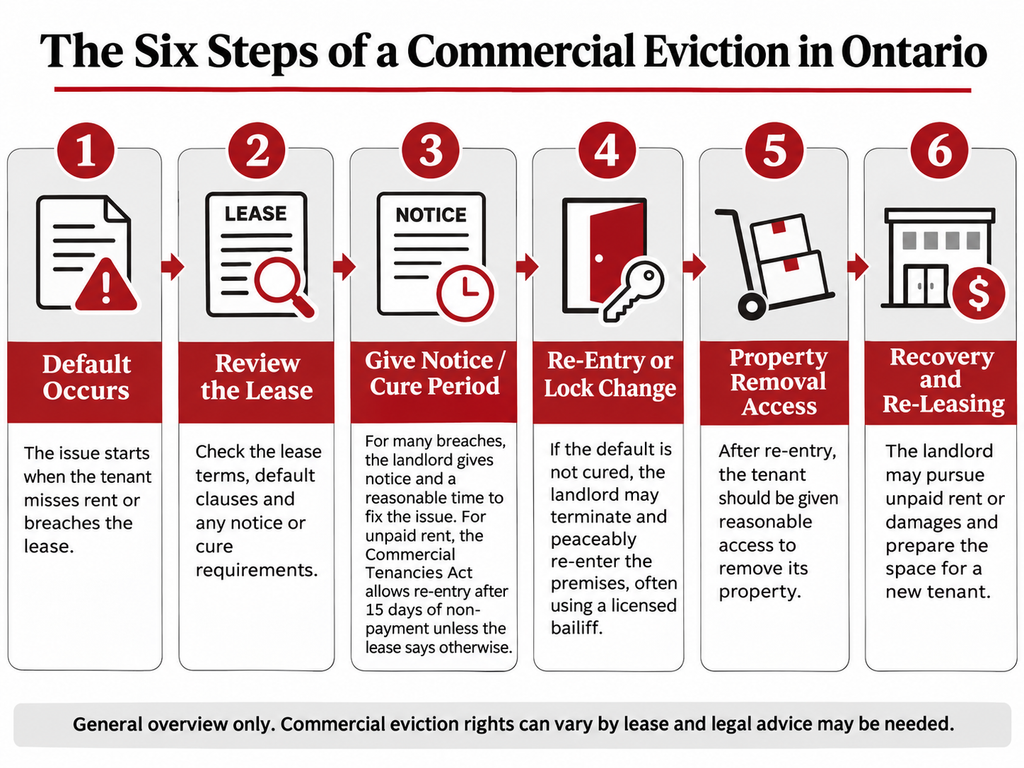
When rent goes unpaid, commercial landlords in Ontario generally have two main paths. Distress keeps the lease in place and allows the landlord to seize and sell the tenant’s goods on the premises to recover arrears, following strict rules. Termination ends the lease, usually through re-entry. Under the Commercial Tenancies Act, a landlord generally has a right of re-entry once rent has been in arrears for 15 days, subject to the lease.
These remedies are generally mutually exclusive. Choosing one can waive the other, and a misstep in either can expose the landlord to liability. Our guide to the Ontario landlord’s escalation ladder for commercial rent arrears explains each option in detail. Collecting rent consistently through a service like our rent collection services is the best way to avoid getting here.
Step 3: Other Breaches Need Notice and Time to Fix
For breaches other than unpaid rent, such as failing to carry insurance, using the space for an unapproved purpose or making alterations without consent, the Commercial Tenancies Act generally requires the landlord to give written notice before ending the lease. The notice should describe the breach, require the tenant to remedy it, and allow a reasonable time to do so. Only if the tenant fails to fix the breach can the landlord move to forfeit the lease.
Skipping this step is one of the most common reasons commercial terminations are challenged.
Step 4: Re-Entry and Changing the Locks
Re-entry must be peaceful. In practice, that means:
- Use a Bailiff: Most landlords retain a bailiff to carry out the re-entry.
- Avoid Confrontation: If the tenant is present and resists, stop and get legal advice.
- Post Notice: Place a notice on the premises confirming the lease has been terminated.
- Inventory and Photograph: Record the contents and condition of the premises.
- Secure the Premises: Change the locks and confirm insurance and utilities are in place.
Step 5: Court Applications and Relief From Forfeiture
When peaceful re-entry isn’t possible, or a tenant stays after the lease has ended, the landlord can apply to the Superior Court of Justice for an order for possession. Tenants can also apply to the court for relief from forfeiture, asking to have the lease reinstated. Courts look at the tenant’s conduct and whether the breach has been or can be fixed. If a lease has simply expired and the tenant won’t leave, our guide to holdover tenants in commercial space explains your rights and the rent you can charge.
Step 6: After the Tenant Is Out
Regaining possession is not the end of the process:
- Tenant’s Property: Follow your lease and get legal advice before moving, storing or disposing of anything left behind.
- Deposits and Guarantees: Apply the security deposit as the lease allows and consider claims against any guarantor or indemnifier.
- Arrears and Damages: You may be able to claim unpaid rent and damages, but you’re generally expected to take reasonable steps to re-let the space.
- Condition Report: Document the state of the premises through property inspection services.
- Re-Letting: Repair, market and re-lease the space, and tighten your process for vetting a commercial tenant’s financials to reduce the risk of a repeat.
Special Situations
Tenant Insolvency or Bankruptcy
If a tenant files for bankruptcy or a proposal, a stay of proceedings can limit what a landlord is allowed to do, and the trustee may have rights over the lease. Get legal advice immediately.
Abandoned Premises
If the tenant appears to have left, document the evidence carefully before re-entering, including dates, photos, unpaid rent and attempts to contact the tenant.
Mixed-Use Buildings
Residential units follow the Residential Tenancies Act and the LTB process, while commercial units follow the lease and the Commercial Tenancies Act. Our mixed-use building property management handles both correctly in the same building.
Mistakes That Cost Commercial Landlords
- Accepting rent after deciding to terminate the lease
- Using distress after terminating, or terminating after using distress
- Re-entering for a non-rent breach without first giving the required notice
- Confronting the tenant during re-entry
- Disposing of the tenant’s property too early
- Failing to document each step
Get Help With Defaulting Commercial Tenants
Enforcement works best when it starts early and follows the lease precisely. Our commercial property management services cover arrears follow-up, notices, coordination with your lawyer and re-letting, whether you own a retail plaza or strip mall, an office building or another commercial property.
We work with commercial landlords across Toronto, North York, Scarborough, Etobicoke, Mississauga, Brampton, Vaughan, Markham, Richmond Hill, Oakville, Pickering and Oshawa. Let’s Talk about your situation.
Frequently Asked Questions
1. Can a commercial landlord change the locks in Ontario?
In some circumstances, yes. The Commercial Tenancies Act and the lease allow re-entry for certain defaults, such as unpaid rent after a set period. Re-entry must be peaceful and usually done with a bailiff. Get legal advice before acting.
2. Does the Landlord and Tenant Board handle commercial evictions?
No. The LTB deals only with residential tenancies. Commercial disputes are decided under the lease and the Commercial Tenancies Act, and go to the Superior Court of Justice when a court order is needed.
3. How long does it take to evict a commercial tenant in Ontario?
It depends on the type of default, the lease and whether the tenant resists. Rent defaults can move quickly through re-entry; non-rent defaults require notice and time to cure first. Contested cases take longer if they go to court.
4. Can I evict a commercial tenant for something other than unpaid rent?
Yes, if the lease allows it. For breaches other than rent, the landlord generally must give written notice describing the breach and a reasonable time to fix it before ending the lease.
5. What happens to the tenant’s belongings after re-entry?
Follow the lease and get legal advice before moving or disposing of anything. Inventory and photograph the contents at re-entry and keep records of every step.