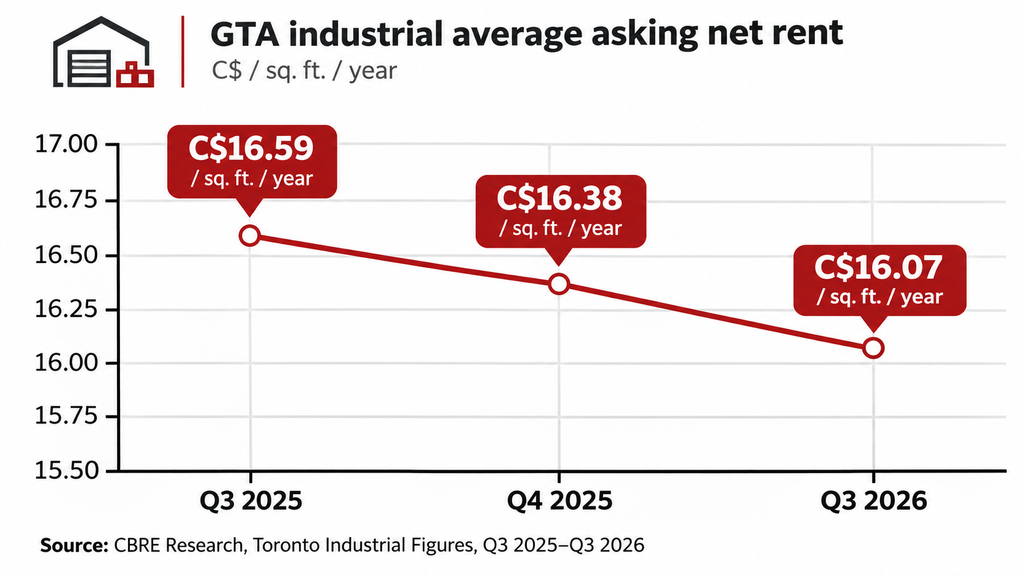
Across the GTA, the average asking net rent for industrial space was $16.11 per square foot in Q2 2026, according to CBRE’s Toronto Industrial Figures. That’s net rent, which means property taxes, insurance and maintenance (TMI) are charged on top.
Rents have eased over the past few years as new supply arrived. CBRE reported that the GTA average asking rate fell from $18.35 per square foot in Q3 2023 to $16.38 by Q4 2025, and that asking rents declined for an 11th consecutive quarter in Q2 2026, although the pace of decline has slowed.
This guide breaks down current warehouse rents by region, what tenants actually pay all-in, what drives the price of a unit, and how owners should price their space in 2026. If you own industrial property, our industrial, warehouse and flex space property management page explains how we help owners keep units leased and recoveries complete.
Current Warehouse Lease Rates in the GTA
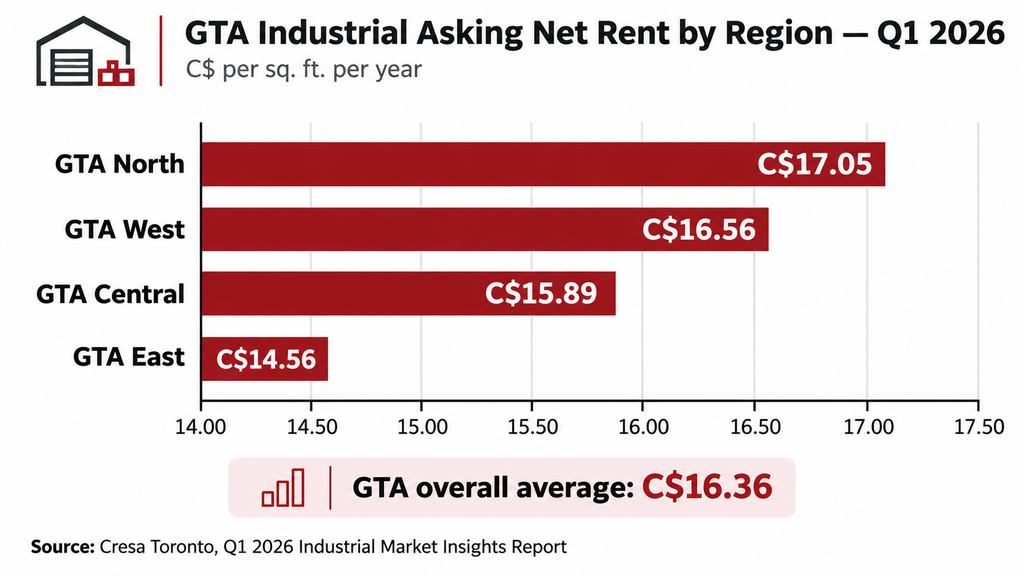
Rents vary across the region. The figures below come from one source and one quarter so they can be compared fairly.
| GTA Region | Avg. Asking Net Rent (PSF) | Source |
| GTA West | $16.56 | Cresa, Q1 2026 |
| GTA Central | $15.89 | Cresa, Q1 2026 |
| GTA North | $17.05 | Cresa, Q1 2026 |
| GTA East | $14.56 | Cresa, Q1 2026 |
In the same report, Cresa put GTA industrial vacancy at 4.1% and availability at 5.8% in Q1 2026. Different brokerages measure the market differently, so rents and vacancy rates from one report shouldn’t be mixed with figures from another. For example, Lee & Associates reported an average NNN asking rate of $18.75 per square foot and vacancy of 3.83% for Toronto in Q3 2026, using its own methodology and inventory.
For a wider view of how rents are moving across asset types, see our guide to GTA commercial rent trends in 2026.
Net Rent vs Total Occupancy Cost
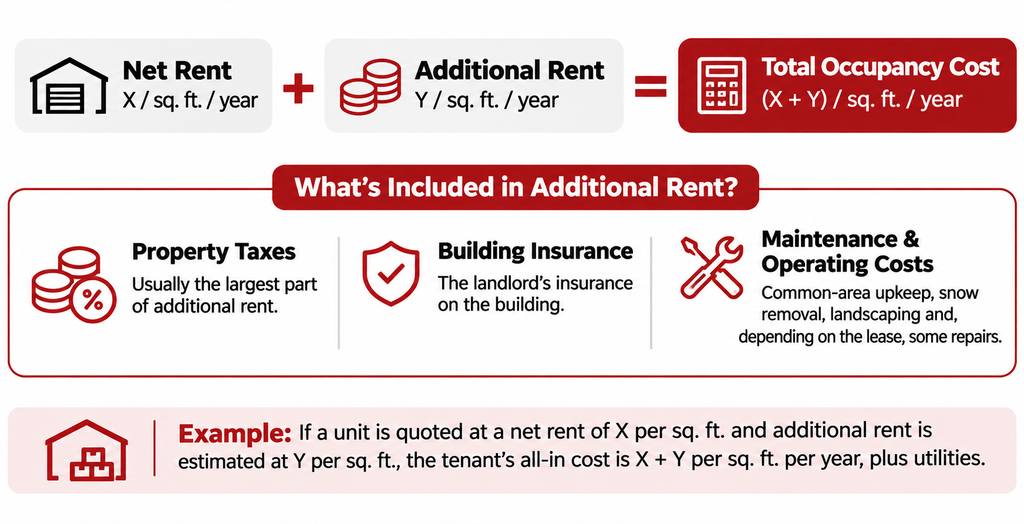
Most GTA industrial space is quoted as net rent. Under a net or triple-net lease, the tenant also pays its share of:
- Property Taxes: Usually the largest part of additional rent.
- Building Insurance: The landlord’s insurance on the building.
- Maintenance and Operating Costs: Common-area upkeep, snow removal, landscaping and, depending on the lease, some repairs.
Total occupancy cost is net rent plus additional rent. For example, if a unit is quoted at a net rent of X per square foot and additional rent is estimated at Y per square foot, the tenant’s all-in cost is X + Y per square foot per year, plus utilities. (Illustrative only; ask the landlord for the current year’s TMI estimate.) Our guide to TMI for Ontario commercial landlords explains how additional rent is budgeted and reconciled.
What Drives the Price of Warehouse Space
Two units in the same city can rent for very different amounts. The main factors are:
- Location and Highway Access: Proximity to the 400-series highways and major logistics corridors.
- Clear Height: Taller clear heights support more racking and storage.
- Shipping Doors: The number of truck-level and drive-in doors, and the depth of the truck court.
- Unit Size: Small-bay units and large distribution buildings serve different tenants.
- Building Age and Condition: Roof, floor slab, lighting and dock equipment.
- Power and Sprinklers: Electrical capacity and sprinkler systems suited to the tenant’s use.
- Office Component: The share of finished office space within the unit.
- Lease Term and Tenant Strength: Longer terms and stronger covenants can affect the rate.
Small Bay vs Large Warehouse Space
Small-bay and multi-tenant industrial units serve a wide pool of local businesses, from trades and light manufacturing to e-commerce and showrooms. Large distribution buildings serve fewer, bigger occupiers. The two segments often move differently, with different rents, vacancy and lease terms. If you own small-bay space, compare your rents with similar units nearby rather than with GTA-wide averages.
Buying vs Leasing: Warehouse Price Per Square Foot
For buyers, CBRE reported an average GTA industrial asking sale price of $372.43 per square foot in Q1 2026. Industrial condominium units can offer a smaller entry point for investors and owner-occupiers. Before you buy, review how commercial property is valued in Canada and how commercial mortgages differ from residential.
For Owners: How to Price Your Warehouse Space in 2026
With rents easing and more space available than a few years ago, pricing matters. Here’s how to approach it:
- Benchmark Against True Comparables: Use similar units in your submarket, not GTA-wide averages. Our property evaluations can help.
- Decide Between Face Rent and Incentives: A lower face rent affects value directly, while free rent or improvement allowances can keep the face rate higher. Talk to your lender before deciding.
- Make Sure Additional Rent Is Recoverable: Confirm the lease allows recovery of taxes, insurance and maintenance, and reconcile it every year.
- Price in Condition: Dock doors, roof, yard and lighting all affect what tenants will pay.
- Count the Cost of Vacancy: Every empty month means lost rent plus taxes and carrying costs you can’t recover.
- Qualify the Tenant: Once the price is set, vet the tenant’s financials before signing.
Turnover is also the time to protect the property. Review environmental conditions at move-out, as covered in our guide to environmental liability for commercial landlords in Ontario, and keep fire protection systems current using our commercial building compliance checklist.
Keep Your Warehouse Space Leased and Performing
Whether you own a single small-bay unit or a multi-tenant industrial building, we can benchmark your rents, check your recoveries and keep your building compliant. Our industrial, warehouse and flex space property management works alongside our property evaluations, accounting and bookkeeping and wider commercial property management services.
We work with industrial owners across Mississauga, Brampton, Vaughan, Milton, Caledon, Scarborough, Etobicoke, Markham, Pickering, Whitby, Oshawa and Burlington. Let’s Talk about your building.
Frequently Asked Questions
1. How much does warehouse space cost per square foot in the GTA?
CBRE reported an average asking net rent of $16.11 per square foot for GTA industrial space in Q2 2026. Taxes, insurance and maintenance are charged on top as additional rent, and rents vary widely by submarket, unit size and building quality.
2. Is warehouse rent in the GTA quoted as net or gross?
Most GTA industrial space is quoted as net rent, with taxes, insurance and maintenance charged separately as additional rent. Always ask for both figures so you can compare the total cost of each unit.
3. Why is small-bay warehouse space priced differently?
Small-bay units serve a wide pool of local businesses and often lease on different terms than large distribution buildings. Rents, vacancy and lease length can move differently between the two segments, so compare small-bay units with similar units nearby.
4. Which GTA areas have the highest industrial rents?
In Cresa’s Q1 2026 report, GTA North had the highest average asking net rent at $17.05 per square foot, followed by GTA West at $16.56. GTA East was the lowest at $14.56.
5. Should I lower my asking rent or offer incentives to lease a vacant unit?
It depends on your lender, your valuation and the market. A lower face rent affects value directly, while free rent or improvement allowances keep the face rate higher. A rent review against comparable units helps you decide.