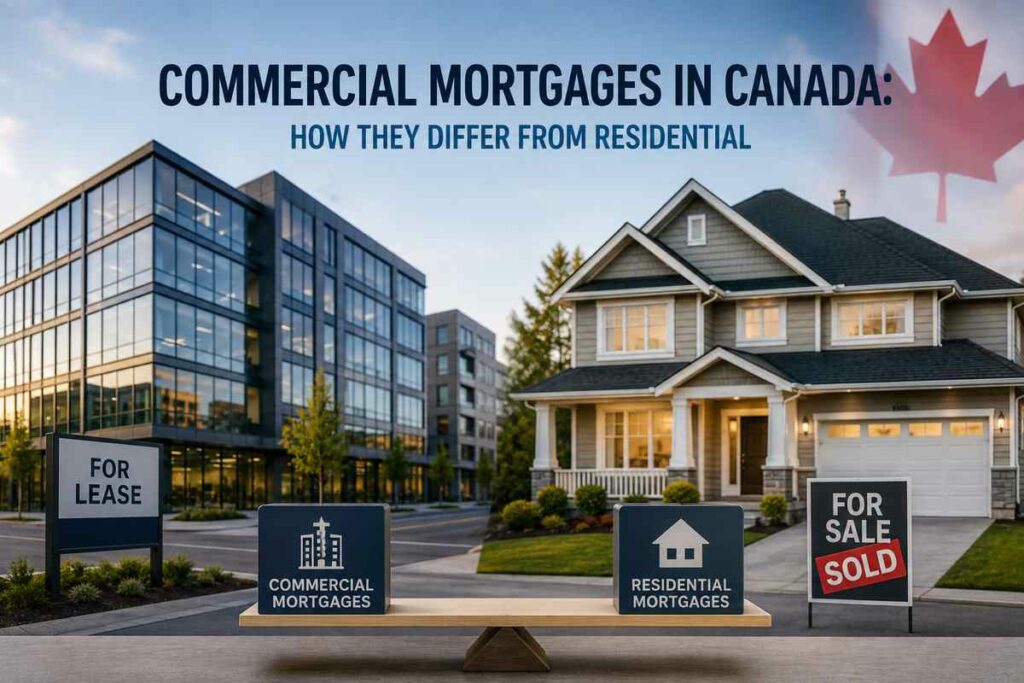
If you’ve financed a home in Canada, you already know the routine: submit your T4s, pull your NOAs, hand over a credit report, and wait a few weeks for approval. That process works because residential lenders are underwriting you – your income, your employment history, your debt ratios. When you walk into a commercial mortgage conversation expecting the same experience, you’re in for a surprise. Commercial lenders aren’t underwriting the borrower first. They’re underwriting the property. Understanding that fundamental shift is the starting point for every successful commercial mortgage in Canada – whether you’re acquiring a retail plaza, refinancing a mixed-use building, or bringing a multi-family asset to a CMHC-insured lender.
This guide covers everything that actually changes when you cross from residential to commercial financing in Canada in 2026: the underwriting logic, down payment requirements, rate structures, document packages, lender types, personal guarantee obligations, and the most expensive mistakes investors make when they underestimate how different the process really is.
The Structural Difference: What Lenders Are Actually Underwriting
In Residential Lending, the Borrower Is the Primary Credit
Residential mortgage approval in Canada centres on the borrower’s personal financial profile. Your T4 slips establish employment income. Your Notices of Assessment confirm taxable income over multiple years. Your credit score signals repayment behaviour. The property itself is collateral – but its income-generating capacity is irrelevant if you earn enough to carry the debt.
In Commercial Lending, the Property’s Income Is the Primary Credit
Commercial lenders flip this equation. The first question they ask is: does this property generate enough net income to service the debt on its own? Your personal financials matter – but they’re secondary to the property’s income picture. The central metric is the Debt Service Coverage Ratio (DSCR):
DSCR = Net Operating Income ÷ Annual Debt Service
A property generating $150,000 in Net Operating Income (NOI) with annual debt service of $120,000 produces a DSCR of 1.25x. Most conventional commercial lenders in Canada require a minimum DSCR of 1.20–1.30x. Below that threshold, the lender either reduces the loan amount or declines. The property simply doesn’t produce enough income to support the financing being requested.
This is why the accounting and bookkeeping service your property manager uses matters so much before you approach a lender. The T12 operating statements, rent rolls, and income/expense reports that lenders request as their first document package are the same records that professional property management accounting produces every month. Investors who self-manage and don’t maintain clean financial records consistently face delays – and sometimes declined applications – because they can’t produce what lenders need.
Beyond DSCR, commercial lenders weigh tenant covenant strength (the financial quality of who’s actually paying the rent), lease term structure, vacancy rates, and the property’s position relative to market rents. Our landlord’s guide to rental property accounting and bookkeeping covers how to track income and expenses in the format lenders expect – and why that discipline pays off well before you need financing.
One number that surprises many investors: even if you self-manage your property at zero management cost, commercial lenders will apply a market management fee – typically 3–5% of Effective Gross Income – as a deduction when calculating underwriting NOI. They’re assessing the property as if it were professionally managed, because the next owner might be. See our breakdown of average property management fees for rentals if you want to understand what benchmark lenders are applying.
Down Payment Requirements: Why 35% Is Often the Starting Point

Residential buyers in Canada are conditioned to think in terms of 5–20% down payments. Commercial real estate operates in a fundamentally different capital range. The specific requirement varies significantly by property type, lender appetite, and whether you’re accessing a conventional or government-insured program.
Down Payment by Property Type – 2026 Benchmarks
- Multi-family residential (5+ units): 20–25% for conventional financing; 5–10% under CMHC MLI Select for qualifying properties.
- Mixed-use (residential + commercial): 25–35%, depending on the ratio of commercial to residential space and the lender’s risk appetite.
- Pure commercial (office, retail, industrial): 30–40%. The higher range applies to smaller markets or properties with short lease terms.
- Special-use properties (restaurants, automotive, hospitality): 35–50%+, or lender discretion. These assets carry higher LTV risk because they’re hard to repurpose if the business fails.
CMHC MLI Select: The Exception That Changes the Math for Multi-Family Investors
For investors acquiring or refinancing qualifying multi-family residential properties, the CMHC MLI Select program offers down payments as low as 5–10% and amortisation periods up to 40 years – a dramatic improvement on conventional terms. The trade-off: borrowers must earn points across three categories (affordability for tenants, energy efficiency, and accessibility/barrier-free design). Premiums range from 0.60% to 4.50% of the loan amount.
Important limitation: CMHC insures qualifying multi-family residential under MLI Select – it does not insure retail, office, or industrial commercial properties under this program. That distinction matters when comparing financing options.
One thing MLI Select borrowers often underestimate: the program’s affordability commitments require sustained occupancy management to maintain compliance. That’s why property management for real estate investors is particularly relevant here – you’re not just managing a building, you’re managing against program-specific performance benchmarks.
If you’re still evaluating which asset class to focus on and where to deploy capital, our guide on how to invest wisely in rental property in Toronto covers the full picture of investment property decision-making in the GTA market.
Interest Rates and Terms
How Commercial Rates Are Quoted – and Why They’re Higher
Commercial mortgage rates in Canada are quoted differently than residential rates. Fixed commercial rates are typically priced as a spread over the Government of Canada bond yield for the matching term – a 5-year commercial fixed rate might be quoted as GoC 5-year + 175 basis points, for example. Variable commercial rates are priced over CORRA or bank prime. In 2026, following the Bank of Canada’s rate-cutting cycle through late 2024 and 2025, a typical conventional commercial fixed rate on a 5-year term falls in the range of GoC 5-year + 150–225 bps, depending on property type, occupancy, and borrower profile.
Commercial rates run 50–150 basis points higher than comparable residential terms for a straightforward reason: lenders are underwriting variable income rather than an employed borrower’s salary. That variability warrants a higher risk premium.
Shorter Terms and the Balloon Payment Reality
Residential borrowers in Canada are accustomed to renewing their mortgages every 5 years on a 25-year amortisation. Commercial mortgages work differently. Most are structured with 3-, 5-, or 10-year terms on amortisations of 20–25 years. At the end of the term, the full remaining balance – the balloon payment – is due. You either pay it out, refinance, or sell.
Balloon payment risk is real and often underestimated, particularly in a rising rate environment. If the property’s NOI has declined or cap rates have expanded between your acquisition and your refinancing date, you may qualify for less financing than you need to pay off the balloon. Protecting the income side of that equation – maintaining occupancy and rent collection – is why our rent guarantee program matters for investors with commercial mortgage obligations: consistent, guaranteed rental income protects the DSCR picture lenders will review when you’re back at the table at renewal.
It’s also worth considering income protection strategies across the holding period. Our guide to rent default insurance in Ontario: what it covers and what it doesn’t walks through how landlord income protection products work and where their limits are – useful context when you’re managing financing obligations against tenant default risk.
Prepayment Penalties: Read This Before You Sign
Commercial mortgages in Canada are typically closed – meaning you cannot prepay the principal without incurring a penalty. The penalty is calculated as the greater of: (a) three months’ interest, or (b) an Interest Rate Differential (IRD) calculated over the remaining term. On commercial mortgages, IRDs are not capped the way they sometimes are on residential products. A borrower who acquired a property with a $3M commercial mortgage at a higher rate and needs to sell at year 3 of a 5-year term can face a six-figure prepayment penalty. Always get a written IRD calculation from the lender for multiple exit scenarios before you commit to a term.
For non-resident investors, the disposition planning layer adds complexity – proceeds, withholding obligations, and CRA clearance certificates all interact with the mortgage structure. Our non-resident property tax services team works with non-resident property owners on exactly this kind of cross-border structure planning.
The Documents Commercial Lenders Actually Ask For
The commercial mortgage document package is significantly more extensive than residential. First-time commercial borrowers are routinely surprised by what’s required – and by how long it takes to assemble if the records haven’t been maintained properly.
Core Document Checklist
- Rent roll: current, with signed leases for each tenant. Must show monthly rent, lease start/end dates, renewal options, rent steps, security deposit amounts, and any rent-free or abatement periods in effect.
- Operating statements: 2–3 years of T12 actuals plus the current year budget. The T12 is a trailing twelve-month income and expense summary – this is the single most scrutinised document in commercial underwriting.
- Vacancy and lease expiry schedule: showing current occupancy, pending renewals, and all lease expiry dates over the next 3–5 years.
- Environmental assessment: Phase I ESA ($2,500–$8,000) required by virtually all institutional lenders. Phase II if Phase I identifies contamination risk.
- Building condition report: structural and systems assessment from a qualified engineer.
- Survey and legal description.
- Property tax bills: last 2 years of actual bills and payment history.
- Insurance certificate: current coverage details and limits.
- Personal financials: personal net worth statement and 2 years of personal NOAs for each principal.
- Entity documents: articles of incorporation, operating agreement, or partnership agreement for the borrowing entity.
- Existing mortgage statement: if refinancing.
The T12 operating statement – item 2 on that list – is where many self-managing investors hit a wall. If you don’t have 24–36 months of clean, categorised income and expense records, assembling this document under application pressure is painful. Our accounting and bookkeeping service produces the exact records lenders need as a standard monthly deliverable, so when financing comes up, the T12 is ready rather than being reconstructed from bank statements after the fact.
The Rent Roll: What Lenders Read First
Of everything in the package, lenders read the rent roll first. It tells them the property’s income story: who’s paying, how much, when the leases expire, whether there’s above- or below-market rent in the mix, and what the occupancy risk profile looks like going forward. A rent roll with multiple leases expiring within 12 months of the financing date will suppress the LTV a lender offers – or prompt a cash-trap structure to protect them against vacancy risk.
The quality of your rent roll is also a function of how well you screened tenants in the first place. Our article on how to vet a commercial tenant’s financials before you sign covers what financially strong tenants look like and why their covenant quality shows up in your financing terms, not just your rent collection.
One note on the operating statement and rent roll together: taken as a set, they’re essentially what our commercial operating budget article describes as the monthly financial reporting owners should be receiving. If you’re getting that reporting monthly, lender document requests become a formality rather than a crisis.
Lenders apply a vacancy factor to the rent roll when calculating Effective Gross Income – typically 5–10% for stabilised multi-family and 10–15% for commercial properties – regardless of current actual occupancy. You can’t argue your way out of it. Model it yourself before underwriting a deal. Our how commercial property is actually valued article covers exactly how appraisers and lenders normalise income to remove the “my building happens to be 100% occupied right now” effect.
Lender Types: Banks, Credit Unions, MICs, and CMHC-Approved Lenders
Schedule A Banks (the Big Six)
Canada’s Schedule A banks offer the most competitive commercial mortgage rates but apply the most stringent qualification criteria. They want stabilised, income-producing assets with strong DSCR, long weighted average lease terms, and borrowers with a track record of managing commercial real estate. First-time commercial investors often find bank credit approval more difficult than expected because banks are comparing them to their entire commercial lending portfolio, not just similar assets in the same market.
One lever that helps: the quality of your property management and financial reporting. A lender reviewing a well-managed asset with clean monthly operating statements, minimal deferred maintenance, and low vacancy will underwrite it more favourably than an equivalent asset managed informally. If you’re planning a bank financing application and your current manager’s reporting doesn’t hold up, our property management company transition service can get the right infrastructure in place before you submit.
Credit Unions and Trust Companies
Credit unions and trust companies occupy the middle of the commercial lending market. They’re typically more flexible on property type, market location, and borrower profile than Schedule A banks – they’ll lend on properties in secondary markets or on assets with shorter lease terms that banks would pass on. Rates run slightly higher than bank rates to reflect the additional risk. For investors who don’t quite meet the bank qualification threshold, credit unions are often the right first institutional lender.
Mortgage Investment Corporations (MICs)
MICs are private capital vehicles that lend where institutional lenders won’t: transitional assets, properties in lease-up, borrowers with recent credit events, or deals that need to close on a timeline that doesn’t accommodate conventional underwriting. Rates are significantly higher – 8–14%+ in 2026 – on terms of 1–2 years. MIC financing is bridge financing: you use it while you stabilise the asset or resolve the issue that disqualified you from conventional financing, then refinance to a lower-rate institutional lender.
CMHC MLI Select Approved Lenders
For qualifying multi-family residential assets, CMHC MLI Select financing flows through approved lenders – the major banks and some credit unions – with CMHC underwriting the insured portion separately. The result is lower rates and longer amortisation than conventional commercial financing, in exchange for meeting the program’s scored commitment thresholds. Phase I and Phase II environmental assessments are still required. The CMHC underwriting layer adds time to the approval process – build it into your conditions period.
Personal Guarantees and Corporate Borrowing
Most commercial mortgage borrowers in Canada structure their acquisitions through a corporation or holding company for liability and tax planning reasons. What many first-time commercial borrowers don’t anticipate: most commercial lenders require a personal guarantee from the principal(s), regardless of the corporate structure. The guarantee is typically full recourse – meaning the lender can pursue your personal assets (house, savings, investment accounts) if the corporation defaults and the property’s liquidation value doesn’t cover the outstanding balance.
Non-recourse commercial mortgage structures do exist in Canada, but they’re typically only available on larger institutional-quality assets – $10M+ – and usually require significant equity, stabilised occupancy, and strong tenant covenants. For most GTA commercial investors, the personal guarantee is a standard feature of the financing, not a negotiation point.
For non-resident investors acquiring Canadian commercial real estate through a Canadian or offshore entity, the personal guarantee structure intersects with cross-border tax obligations – particularly Part XIII withholding tax on rental income. Our non-resident property tax services team advises on the right entity structure and compliance requirements that sit alongside the financing.
Key Mistakes Commercial Mortgage Borrowers Make in Canada
- Underestimating closing costs. Budget 2.5–4% of the purchase price on top of your down payment for: lenders’ legal fees, your legal fees, appraisal ($3,500–$8,000+), Phase I environmental ($2,500–$8,000), title insurance, land transfer tax, and broker fee if applicable. Many first-time commercial buyers are caught short at closing.
- Skipping the vacancy factor in their own income projections. Lenders apply it regardless of current occupancy. See how vacancy rates impact your rental income in Durham Region for context on why vacancy assumptions matter even for fully occupied buildings.
- Ignoring lease expiry risk. A retail plaza with 6 of 10 leases expiring within 18 months of your financing date is a fundamentally different risk profile than the same property with staggered 5-year terms. Lenders see it, price it, and sometimes condition around it. Our guide on how to vet a commercial tenant’s financials before you sign covers what strong lease structures look like when you’re acquiring a tenanted property.
- Choosing the wrong lender for the property type. A MIC is not the right lender for a stabilised multi-family building. A Schedule A bank is not the right lender for a transitional asset in lease-up. Mismatching lender type to property stage wastes time and costs money.
- Not understanding the prepayment penalty before signing. Always request an IRD calculation from the lender for at least two exit scenarios – year 2 and year 4 of a 5-year term – before you commit. The number will surprise you.
- Ignoring the operating budget in acquisition underwriting. A property that looks profitable on gross rent can be deeply cash-flow negative when you account for property taxes, insurance, maintenance, management fees, capital reserves, and debt service. Our commercial operating budget article outlines every line item owners need to understand before they model a deal. The hidden time cost of self-managing a Toronto investment property is particularly relevant for investors who are modelling zero management cost into their projections.
Frequently Asked Questions
What is the minimum down payment for a commercial mortgage in Canada?
Typically 25–35% for conventional commercial financing, depending on property type, lender, and DSCR. Multi-family residential (5+ units) can qualify for 5–10% down under CMHC MLI Select if the property meets the program’s affordability, energy, and/or accessibility commitments. Special-use properties (restaurants, automotive, hospitality) often require 40%+, and some lenders won’t touch them at any LTV.
Are commercial mortgage rates higher than residential in Canada?
Yes – typically 50–150 basis points higher on a comparable term. Commercial lenders are underwriting a property’s variable income rather than an employed borrower’s salary, and that risk differential is priced into the spread. MIC rates are significantly higher still – 8–14%+ – reflecting the bridge or transitional nature of that financing.
Do commercial lenders require a personal guarantee?
In most cases, yes – particularly for loans under $10–15M. Even when the borrowing entity is a corporation, most lenders require the principal to provide a full recourse personal guarantee. Non-recourse structures are generally reserved for larger institutional-quality assets with strong DSCR and long-term credit tenants.
What is a DSCR and why does it matter?
Debt Service Coverage Ratio = Net Operating Income ÷ Annual Debt Service. Most conventional commercial lenders in Canada require a minimum of 1.20–1.30x. A DSCR below the lender’s threshold means the property doesn’t generate enough income to support the requested loan amount – the lender will reduce the advance or decline the application. Clean monthly financial reporting from your accounting and bookkeeping service makes your NOI calculation transparent and defensible.
Can a non-resident of Canada get a commercial mortgage?
Yes – commercial lending is generally less restrictive than residential lending for non-residents because underwriting is based on the property’s Canadian income rather than the borrower’s personal income from a foreign jurisdiction. That said, lenders will still require a personal guarantee, and the borrowing entity must typically be Canadian. Non-residents also need to comply with Part XIII withholding tax obligations on Canadian rental income. Our non-resident property tax services team handles both the tax compliance and the cross-border structuring questions.
How long does commercial mortgage approval take in Canada?
Significantly longer than residential. A clean conventional commercial deal typically takes 4–8 weeks from complete application to commitment letter. The Phase I environmental assessment adds 3–6 weeks. CMHC MLI Select applications add CMHC’s own underwriting timeline on top of the lender’s. Build these timelines into your purchase agreement conditions – 30-day financing conditions are not workable for commercial. Our how commercial property is actually valued article covers the appraisal process in detail, including what appraisers look for and how to prepare.
Managing a Commercial Property Portfolio in the GTA?
Financing is step one. Managing the asset – maintaining occupancy, collecting rent, controlling operating expenses, and producing the financial reports your lender requires at renewal – is what determines whether the investment actually performs over time.
→ Property Management for Real Estate Investors (manageyourproperty.ca/our-services/property-management-for-real-estate-investors/)
→ Accounting & Bookkeeping (manageyourproperty.ca/our-services/accounting-and-bookkeeping/)
→ Non-Resident Property Tax Services (manageyourproperty.ca/our-services/non-resident-property-tax-services/)
→ Property Management Company Transition (manageyourproperty.ca/our-services/property-management-company-transition/)